


– Adi Paz, Executive Vice President of Marketing and Business Development at GigaSpaces, says:
GigaSpaces Cloudify solution enables the on-boarding of applications onto any cloud. For several months now, GigaSpaces has been working with Alcatel-Lucent (ALU) on the use of Cloudify in a carrier cloud service environment. Together with Alcatel-Lucent’s CloudBand™ solution, Cloudify is a fundamental building block in the technological backbone of ALU’s carrier-grade Platform-as-a-Service (CPaaS).

Dor Skuler, Vice President & General Manager of the CloudBand Business Unit at Alcatel-Lucent, has said that, “Offering CPaaS as part of the CloudBand solution enables service providers to make a smooth migration to the carrier cloud and quickly deploy value-added services with improved quality and scalability, without the need for dedicated equipment.”
This new class of carrier cloud services brings the benefits of the cloud to the carrier environment without sacrificing security, reliability and/or quality of applications. The CPaaS enables the on-boarding of mission-critical applications on a massive scale, including both legacy and new carrier cloud services. This is a factor in meeting the requirements of many customers’ Service Level Agreements (SLAs) by integrating carrier networks.
Unlike regular cloud environments, where an application needs to explicitly handle multi-zone deployments, CPaaS enables the application workload and availability to be handled through a policy driven approach. The policy describes the desired application SLA, while the carrier CPaaS maps the deployment of the application resources to the cloud and reflects the best latency, load, or availability requirements.
Additionally, the integration will enable the creation of network-aware CPaaS services, simplified on-boarding to ALU’s CloudBand platform, multi-site app deployment and simplification of management of a number of latency and location-sensitive applications. The ability to comply with five-nine reliability, security, and disaster recovery requirements ensures peace-of-mind for enterprises choosing to on-board mission-critical applications to the carrier network.
The Cloudify Approach
Cloudify manages applications at the process level, and as such uses the same underlying architecture for any application regardless of the language or the technology stack that comprises the application. That said, working at the process level is often not enough, because not all processes are made the same. For example, databases behave quite differently from web containers and load-balancers. In order for us to still get in-depth knowledge about the managed application’s processes, Cloudify uses a recipe-based approach. The recipe-based approach enables us to describe the elements that are specific to that individual process, such as the configuration element, the dependency on other processes, the specific key performance indicators that tell if that process’ behavior is aligned with its SLA, and so on.
Working on the process level makes it possible to plug into a large variety of infrastructures, whether they happen to be public, private, or bare-metal environments. Cloudify uses an abstraction layer known as the Cloud Driver that interfaces with the cloud infrastructure to provide on-demand compute resources for running applications.
that interfaces with the cloud infrastructure to provide on-demand compute resources for running applications.
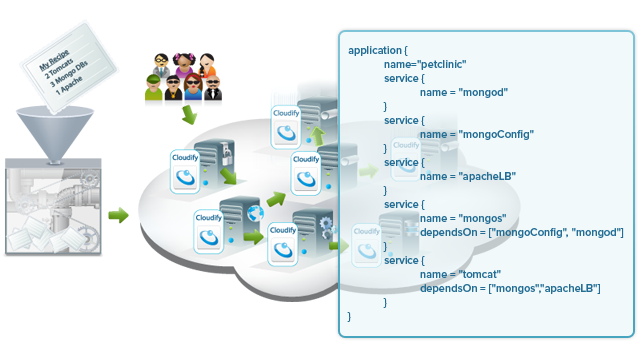
The Cloudify process can be implemented be done on individual clouds from HP, Microsoft, IBM, CloudStack, etc., or in the carrier network infrastructure of a company like Alcatel-Lucent.
Adi Paz is responsible for developing and communicating GigaSpaces’ strategy, and managing the company’s go-to-market activities and strategic alliances. Prior to joining GigaSpaces, Paz served as VP of Marketing and Products and VP of Business Development at Radvision, specializing in selling and marketing solutions to the developer and enterprise markets. Adi also held senior Product Management and Business Development positions at Starhome, a Comverse company, focusing on the carrier market.
