TL; DR
- Sustainability in digital infrastructure starts before a data center opens, with construction methods playing a major role in environmental impact.
- Modular construction reduces disruption by shifting much of the work off-site, which can lower noise, traffic, waste, and the project’s overall carbon footprint.
- The article frames human sustainability as part of the equation, arguing that factory-based work can improve worker stability, safety, retention, and quality of life.
- Long-term community value matters as much as speed or efficiency, so Mod42 emphasizes workforce development, local partnerships, and future community initiatives alongside infrastructure delivery.
# # #
Digital infrastructure is expanding at unprecedented rates. AI workloads, cloud migration, and edge computing are driving data center demand to record levels. The International Energy Agency estimates global data center power consumption could reach 1,050 terawatt-hours by 2026, approximately equivalent to Japan’s entire electricity use.
This growth creates a critical question: How do we build the infrastructure the future needs while minimizing impact on the environment and communities where it sits?
The answer isn’t just about cleaner energy or better cooling. It also requires rethinking how data centers are delivered. Sustainability and community aren’t separate concerns. They’re interconnected challenges that demand integrated solutions.
Sustainability is often discussed in terms of what a facility consumes once it is online. But for data centers, sustainability also starts long before operations begin. It includes how the project is built, how much disruption it creates, and how it affects the people and places around it.
Modular Construction: Reducing Physical Impact
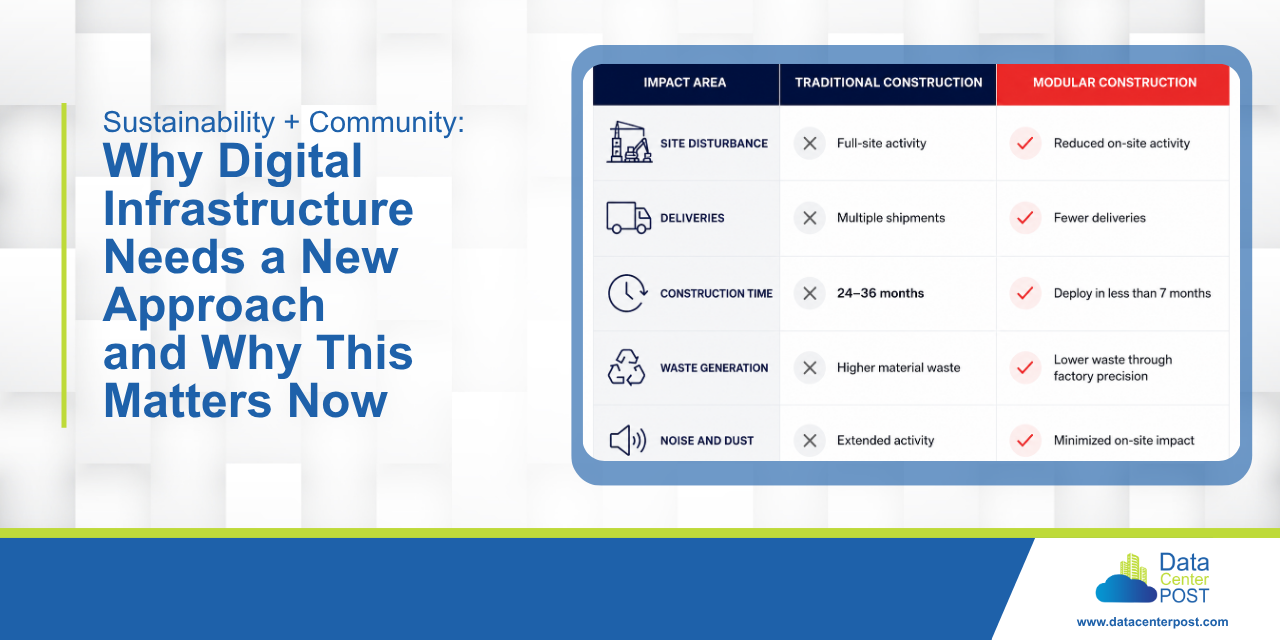
Traditional data center construction can create years of noise, dust, debris, heavy truck traffic, and ongoing disruption for nearby communities. Modular construction changes that pattern by moving much of the work off-site while site preparation happens in parallel. Instead of a long period of active construction on location, the completed modules are delivered and installed in a much shorter window, reducing the duration of construction-related disruption. That makes modular construction a more community-friendly approach from the start, not just a faster one.
By shifting a large share of the work into factory environments, teams can reduce site activity, limit deliveries, and shorten the overall construction window. At Mod42, much of the data center is pre-engineered and manufactured off-site, which helps move the work from a crowded job site into a more controlled setting.
That shift matters for more than speed. It reduces on-site disturbance, lowers material waste, and shrinks the project’s overall carbon footprint. Because modules are built in a factory with lean, repeatable processes, material use is optimized and excess is minimized. Construction is one of the largest contributors to landfill waste; modular’s lean approach significantly cuts that waste at the source.
Modular construction is also more land efficient. Building in a controlled factory environment allows more capacity to be delivered on a smaller site. For example, Mod42 can fit up to 15 MW of data center capacity on a single acre, whereas a traditional build would typically require more land to deliver the same power. That reduced land disturbance means less grading, fewer impervious surfaces, and a smaller physical footprint for the same MW; this is another way modular lowers environmental impact before the facility even turns on.
The environmental benefit is not only in what gets built, but in how it gets built. Factory manufacturing creates far less construction waste because materials are used more efficiently, processes are repeatable, and excess is reduced. Construction remains one of the largest contributors to landfill waste, so minimizing waste at the manufacturing stage is an important part of a more sustainable model. Factory precision also helps improve consistency and quality while reducing unnecessary material use.
This is the key point: Construction methods and community impact are also central to sustainability.
Human Sustainability: The Workforce Angle
Sustainability is often discussed in terms of energy, water, and emissions. But there is another important dimension: human sustainability. That means thinking about the skilled workers who build this infrastructure, the stability of their jobs, and the quality of life that comes with a more predictable work environment.
Traditional construction projects can require long commutes, temporary relocation, and extended time away from home. That affects worker quality of life, retention, and consistency across projects.
Factory-based modular construction helps create stable, consistent employment for skilled workers. Instead of moving from project to project and spending more time traveling, employees return to the same workplace each day, build deeper expertise, and spend more time with their families. That consistency can reduce burnout, improve retention, and support a stronger workforce over time. It also allows experienced teams to build the same products repeatedly, helping deliver greater consistency and quality across every project.
When workers are not constantly moving between distant job sites, they are better able to stay connected to their communities and families. Over time, that stability can benefit both the workforce and the projects they support.
Manufacturing off site also creates a safer, more stable working environment. Workers are inside, protected from extreme heat, cold, rain, and/or sun. That sheltered setting reduces weather-related downtime and fatigue, supports steadier productivity, and helps keep projects on schedule. In other words, protecting the human element directly supports project performance.
Community Engagement Beyond Construction
A data center may be built in months, but its relationship with a community lasts much longer. That means the conversation should extend beyond construction timelines and operational performance. The broader discussion is also about workforce sustainability, employee retention, long-term skilled labor development, and the quality of life of the people doing the work.
Some of the most practical ways that shows up include:
- Sharing more transparent and efficient building practices.
- Supporting sustainability education and green software learning.
- Creating pathways for students and local residents to enter technical trades.
- Partnering with workforce and industry organizations that build long-term capacity.
Looking ahead, Mod42 is also exploring ways to give back in the communities where it builds. That could include initiatives such as tree planting, park enhancements, and other community projects that create lasting value beyond the infrastructure itself. Combined with the company’s support for workforce development, these efforts reflect Mod42’s belief that building digital infrastructure also means making a positive contribution to the communities it serves.
These efforts are not separate from infrastructure development. They are part of what makes that infrastructure more sustainable over time.
What’s Coming Next for Digital Infrastructure
Several trends are changing how digital infrastructure is planned and evaluated.
As AI infrastructure demand accelerates, communities are paying closer attention to how data centers are built, not just how they operate. At the same time, owners are looking for ways to reduce waste, shorten construction schedules, and minimize disruption without compromising quality.
Talent is another factor. As the industry grows, so does the need for skilled workers who can support design, manufacturing, and deployment at scale. Companies that make workforce quality a priority are likely to be better positioned for the future.
Taken together, these trends point in the same direction. The industry needs infrastructure models that are faster, more adaptable, and more considerate of both environmental and human impact.
The Path Forward
The future of digital infrastructure will depend on more than speed. It will depend on whether the industry can build in ways that are efficient, responsible, and respectful of the communities involved.
Sustainability, workforce, and community impact are no longer separate conversations. They are all part of delivering better digital infrastructure. They are part of the same conversation. Reducing construction impact, supporting workers, and investing in local relationships all contribute to better infrastructure outcomes.
Mod42 is continuing to explore additional sustainability initiatives and industry partnerships that support long-term environmental stewardship, workforce development, and community engagement.
This is the perspective behind Mod42’s approach: Build infrastructure that can meet demand while also reducing disruption and supporting the people around it.
Ready for a faster, more sustainable approach to AI infrastructure deployment?
Connect with the Mod42 team to learn how volumetric modular construction can help reduce disruption, improve efficiency, and accelerate delivery. Get started today: mod42.com/quote.