TL;DR
- Mod42 and Duos Technologies Group joined Oracle and Radiant at DCD Connect | Virginia 2026 to examine where modular construction can accelerate AI infrastructure delivery—and where operational and design challenges remain.
- Mod42’s Valerie Crafton emphasized factory-built, integrated infrastructure and phased capacity delivery, while Duos’ Kristen Sanderson shared a practical deployment example from Columbus, Georgia.
- The discussion positioned modular as a construction methodology rather than a temporary container solution, with success dependent on customer requirements, maintainability, supply-chain planning, and repeatability.
# # #
The question was whether modular construction represents a transformative shift or temporary hype, but the discussion at DCD Connect | Virginia 2026 quickly moved beyond the label: where can off-site construction shorten the path to usable capacity, and what must operators get right to realize those benefits?
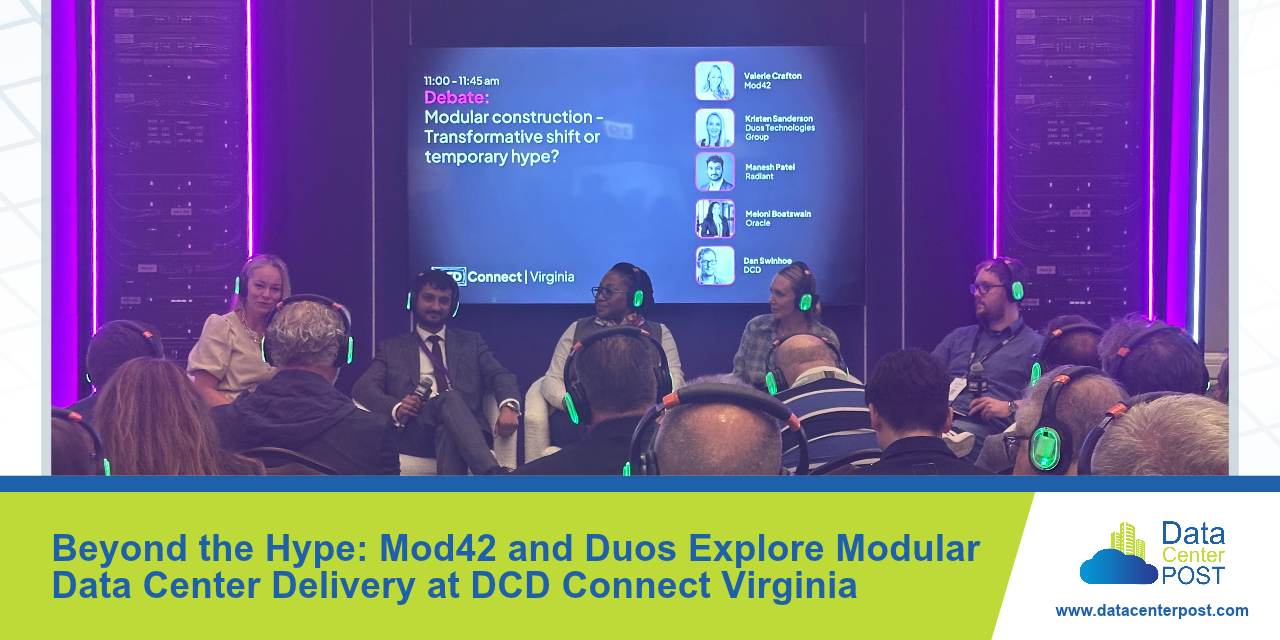
During the November 4 session, “Debate: Modular construction – Transformative shift or temporary hype?,” Valerie Crafton, Chief Revenue Officer at Mod42, and Kristen Sanderson, Senior Vice President at Duos Technologies Group, brought complementary perspectives on factory-built infrastructure and customer-driven deployment.
Moderated by DCD Editor in Chief Dan Swinhoe, the panel also featured Meloni Boatswain, Director of Data Center Infrastructure Delivery at Oracle, and Manesh Patel, Head of Data Center Development at Radiant. Together, they explored how modular approaches can address construction constraints without overlooking the operational, technical, and economic realities of running a data center.
A Methodology, Not a Container
Both Crafton and Sanderson challenged the assumption that modular data centers are simply shipping containers repurposed for compute, describing purpose-built buildings and integrated infrastructure designed around customer and site requirements.
For Mod42, Crafton described an approach that extends beyond prefabricated electrical or cooling equipment to the broader AI facility, integrating systems in a factory environment and adapting configurations to the technology being deployed. Sanderson similarly emphasized that modular buildings can be designed for regional conditions and incorporated within conventional building shells when customers require additional enclosure or security.
The panel also examined the scheduling advantage of parallel execution: while site construction progresses, electrical rooms and mechanical systems can be assembled off-site rather than waiting for the building to be completed. The distinction matters because modular delivery can change the sequence of construction, not simply the location where individual components are built.
Turning Speed Into Revenue
Crafton connected faster delivery to earlier revenue generation, explaining that customers do not necessarily need to wait for an entire campus to be completed before bringing initial capacity online. Phased deployment, she argued, allows infrastructure to begin serving demand while subsequent capacity is delivered.
Sanderson offered a practical example from Duos’ work in Columbus, Georgia, where the company repurposed a vacant building using modular electrical houses and chillers. She described an approximately 7 MW critical-load deployment at a site capable of scaling to 20 MW, with capacity brought online in phases as the customer prepared its computing equipment.
That example illustrated the different scales and applications represented on the panel: Duos’ discussion focused on customer-specific deployments of roughly 1–20 MW, while Crafton addressed how factory-built infrastructure can support phased delivery at larger campus scale.
Flexibility Requires Deliberate Design
The debate was not an unqualified endorsement of modular construction, with Boatswain questioning how prebuilt infrastructure can accommodate changing customer requirements, including a shift from air-cooled workloads to denser, liquid-cooled systems.
Patel raised related concerns about maintenance access, equipment replacement, and land constraints, emphasizing that a faster construction process must also produce a facility that works operationally. Standardization, in other words, cannot substitute for planning how equipment will be serviced, replaced, or upgraded.
Sanderson explained that Duos addresses these considerations through customer-specific design, redundancy, and replaceable units, while future expansion can incorporate different modules or buildings as requirements evolve. Crafton likewise acknowledged that modular is not the right economic fit for every project, even as she urged developers to evaluate it seriously given the industry’s delivery challenges.
“I think it’s a greater risk not to consider it at this point,” Crafton said.
Workforce and Community Opportunities
Factory-based construction also prompted a discussion about workforce development, with Crafton describing how repeatable tasks and controlled working conditions can support training while reducing exposure to weather-related disruption. Boatswain connected that opportunity to a broader need to introduce students and emerging tradespeople to careers in digital infrastructure.
For Sanderson, the Columbus project demonstrated a community dimension as well: she described using local labor, working with community leadership, and hiring interns as Duos develops its infrastructure footprint.
Crafton highlighted the potential to reuse industrial buildings, while Sanderson cautioned that available power alone is not enough—appropriate network connectivity must also be part of the site equation.
Repeatability Without One-Size-Fits-All
Panelists were equally clear that modular construction does not eliminate supply-chain constraints, with long-lead equipment and smaller components still capable of delaying delivery. Their discussion emphasized forecasting, supplier coordination, and repeatable designs as ways to manage—not erase—those risks.
Patel stressed the value of repeating familiar delivery and commissioning processes across projects, while Crafton encouraged engineering choices that respond to equipment availability and customer needs rather than defaulting to conventional designs.
Sanderson’s closing perspective captured the customer-first discipline behind those decisions: “It’s not what we want. It’s what we’re building for them.”
Learn more about Mod42 and Duos Technologies Group.