
TL;DR
- Communities are becoming a critical factor in digital infrastructure deployment as public understanding, permitting, and local governance increasingly influence the success of AI, data center, and connectivity projects.
- AI infrastructure is evolving beyond hyperscale facilities into distributed edge deployments, creating new opportunities and planning challenges for municipalities, public safety agencies, and underserved markets.
- Local governments are being asked to make highly technical decisions about AI, sovereign AI, cybersecurity, bandwidth, and infrastructure ownership without adequate education, staffing, or strategic guidance.
- The OIX Digital Infrastructure Framework Committee (DIFC) is working to provide communities with practical planning frameworks that help city leaders evaluate digital infrastructure responsibly while supporting long-term economic growth and competitiveness.
# # #
At Connected America 2026, which focus on strategy, business models and innovation fo telecom operators, government bodies and their partners, one message became abundantly clear: the future of AI, connectivity, and economic competitiveness will depend not only on technology itself, but on whether communities are prepared to understand, evaluate, and plan for digital infrastructure responsibly.
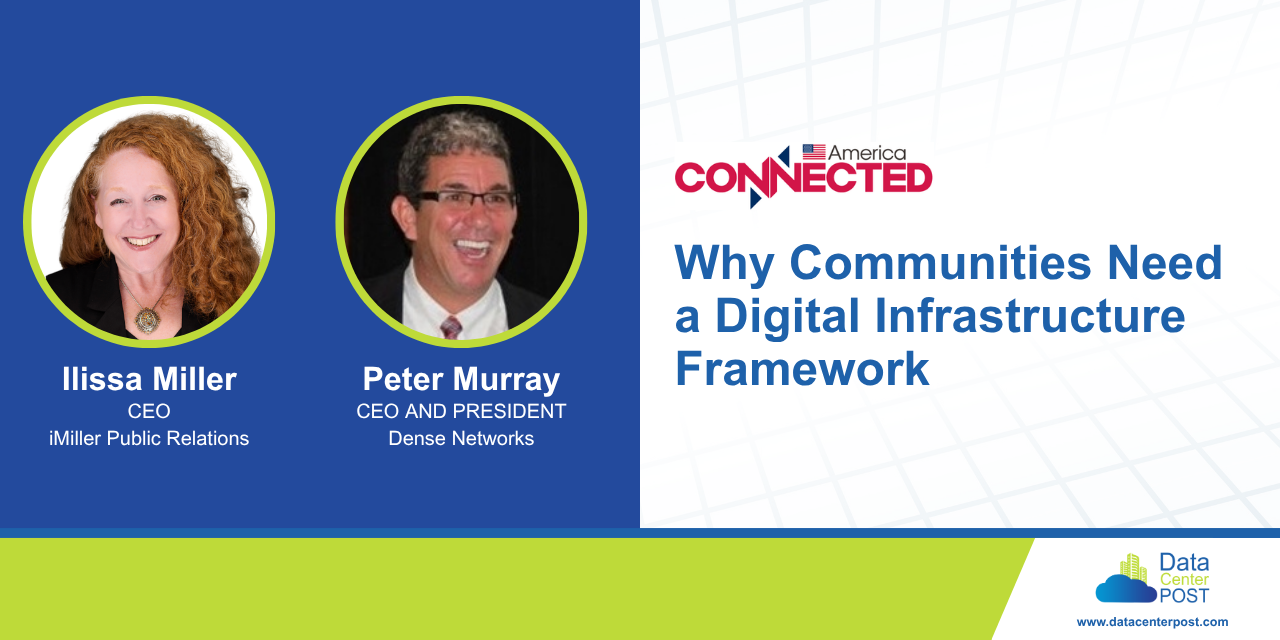
During a fireside chat titled From Resistance to Readiness: Why Communities Need a Digital Infrastructure Framework, Ilissa Miller, CEO of iMiller Public Relations and as the Chair of the OIX Digital Infrastructure Framework Committee (DIFC), joined Peter Murray, CEO and President of Dense Networks, for a candid discussion about the growing disconnect between infrastructure deployment and public understanding. The conversation explored everything from AI infrastructure and sovereign AI to edge deployments, municipal readiness, public trust, and the urgent need for education and engagement.
The discussion was grounded in a simple but increasingly urgent reality: digital infrastructure is no longer optional. It is becoming foundational to economic growth, government operations, public safety, and national competitiveness.
The AI Infrastructure Race Has Already Begun
Miller opened the conversation by framing the broader geopolitical implications behind the surge in data center and AI infrastructure development. “We’re in the global race for AI dominance. That means that countries are out there trying to attract investment, innovation on that front line, and that also means countries are working against us.”
As communities across the United States confront proposals for new data centers, edge deployments, and fiber expansion, Miller emphasized that much of the public conversation is being driven by misunderstanding, oversimplification, and fear. “Not all data centers are created equal,” Miller explained. “You’ve got edge data centers, commercial enterprise data centers, cloud data centers, AI data centers, data centers sitting at the edge of a cell tower. They’re all called data centers, but nobody’s asking the right questions.”
That lack of clarity, she argued, is creating resistance rooted not necessarily in opposition to technology itself, but in uncertainty and lack of empowerment.
Municipalities Are Being Asked to Solve Problems They Don’t Yet Understand
Throughout the discussion, Murray reinforced the challenges local governments face as AI adoption accelerates faster than public sector planning capabilities.
“Most municipalities don’t have an innovation person,” Murray noted. “It really does take someone with the knowledge of the technology beyond the day-to-day to look at the overall environment and how the incentives are there for industry and growth.”
One of the key themes explored was the emergence of “Sovereign AI”, which is the need for governments and public safety agencies to securely manage and control sensitive data and AI systems internally.
Murray explained that municipalities are increasingly confronting difficult questions around bandwidth, security, compliance, and infrastructure ownership as AI becomes embedded into police, emergency response, transportation, and government systems.
“The municipalities are seeing high usage now taking place on their chatbots and internal uses of AI,” Murray said. “But on the other end of it, they have these critical applications that have regulations that require that they control their information and the data isn’t leaked or corrupted in any way.”
Miller emphasized that communities are not being given sufficient guidance on how to navigate these increasingly complex decisions.
“Nobody’s telling them how to do this, why they need to be doing it, how to navigate it, what questions to ask,” she said. “They need to be empowered with the information, the data points, and the ability to implement this in a very complex environment.”
Edge Infrastructure Will Shape the Next Wave of Community Development
The conversation also explored how AI infrastructure is evolving beyond hyperscale facilities into distributed edge deployments closer to population centers and public services.
Miller described what she called the “edge inference problem,” the challenge of deploying smaller, localized digital infrastructure environments that can support next-generation AI applications in cities and municipalities.
“Edge deployments will empower cities, municipalities and businesses with a competitive advantage,” Miller said, “if we’re saying no to large-scale data center developments, do we think they’re going to be saying no to these smaller edge inference locations?”
Murray pointed to growing opportunities in Tier 2 and underserved markets, particularly as federal broadband and connectivity investments continue to expand.
The discussion highlighted how digital infrastructure creates what the industry commonly refers to as “data gravity,” which is the idea that connectivity and compute resources naturally attract additional businesses, applications, and economic development.
“Digital infrastructure attracts other data points,” Miller explained. “Data gravity attracts other data applications and data usage.”
Why the Digital Infrastructure Framework Matters
A major focus of the session centered on Miller’s work leading the OIX Digital Infrastructure Framework Committee (DIFC). The initiative aims to provide communities with practical guidance for evaluating and planning digital infrastructure projects.
Miller described the framework as an effort to bring structure, consistency, and long-term planning into infrastructure conversations that are often reactive and fragmented.
“The purpose of this framework is to provide a guidance planning document for city planners to implement digital infrastructure into their master plans,” Miller said.
She warned that communities failing to understand the strategic importance of digital infrastructure risk losing businesses, investment, and competitiveness over time.
“If we do not know the importance of that to government services, to business services, let alone to consumers, we are going to have a mass migration of businesses relocating across the country to where that data is.”
The framework initiative reflects a broader shift happening across the industry: moving conversations away from conflict and toward preparedness, planning, and informed decision-making.
A Call for Industry Engagement
One of the strongest moments in the fireside chat came when both Miller and Murray challenged industry professionals to become more actively involved at the local level.
Miller urged attendees to volunteer for planning boards, zoning committees, and local government advisory groups.
“Go to your local municipality and volunteer for your land use boards. Volunteer for your planning committees,” Miller said. “They need help. They do not know all this infrastructure, what it is and how to use it.”
Drawing on her own experience as a former elected official, she emphasized that many local leaders are being asked to make decisions about highly technical infrastructure without sufficient expertise or guidance.
Murray echoed the importance of education and public engagement, sharing examples of municipalities struggling with infrastructure planning despite significant funding opportunities.
“They don’t know what they don’t know,” Murray said. “One big voice can make a big difference in those areas.”
Building Trust Through Education and Transparency
As the session concluded, Miller emphasized that successful infrastructure deployment will require more than engineering and investment. It will require empathy, transparency, and trust.
“Before you say no, know what you’re saying no to,” Miller said. She encouraged attendees to continue having difficult but necessary conversations with communities about the realities, tradeoffs, and opportunities associated with digital infrastructure development.
“Have compassion and empathy when you’re doing that,” Miller advised. “We don’t all have to agree. That’s why this is a paradox. It’s both good and it’s bad, but we all have to figure out how to navigate this together.”
In many ways, the fireside chat captured a defining challenge for the next decade of infrastructure development: how to balance rapid technological advancement with public understanding, local governance, and long-term community planning.
As AI adoption accelerates and connectivity becomes even more foundational to society, the industry’s ability to move communities from resistance to readiness may ultimately determine how successfully the next generation of digital infrastructure gets built.
To learn more about Connected America and to save your seat at the next one, visit www.terrapinn.com/conference/connected-america/index.stm.
For information about the OIX DIFC, visit www.oix.org.
For support navigating community concerns, learn more about the Groundswell™ program offered by Miller’s company here www.imillerpr.com/community-engagement.

