TL;DR
- Unprecedented electricity demands from massive AI workloads, where individual server racks can exceed 100 kW, are overwhelming traditional electrical architectures, making robust power design a key differentiator for hyperscale data centers.
- Operators are shifting to “super-grid” transformers that connect directly to high-voltage transmission networks (at 380 kV or above). This direct link bypasses local distribution networks, dramatically reducing transmission energy losses and boosting overall reliability.
- Connecting directly to the transmission grid allows the Wustermark site to operate on 100% certified renewable energy, utilize 2N electrical redundancy, and support a “zero-generator” backup strategy.
# # #
As artificial intelligence (AI) reshapes the global digital economy, the conversation around data centers often focuses on graphics processing units (GPUs), liquid cooling, and high-density compute. Yet behind every AI workload sits a less visible but critical piece of technology – the transformer.
These systems rarely attract headlines, but they have become foundational to the future of hyperscale infrastructure. Transformers regulate voltage, stabilize power delivery, and enable electricity to move efficiently from generation sources to compute environments. Without them, large-scale AI deployment simply cannot happen.
Today’s hyperscale campuses consume unprecedented amounts of electricity. AI training clusters operate continuously at massive scale, while rack densities continue to climb well beyond traditional enterprise thresholds. In this environment, power infrastructure is no longer a utility consideration buried in the background of facility design. Instead, it has become a strategic differentiator.
This shift is particularly visible in Europe, where data center operators are increasingly redesigning electrical architecture around transmission-level connectivity, renewable integration, and long-term sustainability goals.
Why traditional electrical architectures are under pressure
Transformer technology is based on the electromagnetic induction principle first demonstrated by Michael Faraday in the nineteenth century. Alternating current flowing through a primary winding creates a magnetic field that induces voltage in a secondary winding. By adjusting winding ratios, transformers either increase or decrease voltage depending on operational requirements.
That capability is central to modern power transmission. Electricity transported at higher voltages experiences lower current flow, dramatically reducing load related energy losses during transmission. Since power loss rises in proportion to the square of the current, minimizing current becomes essential for efficiency at scale.
Conventional data center infrastructure has historically relied on multiple stages of voltage transformation between the utility grid and the server floor. However, AI-scale environments are exposing the limitations of this approach.
Modern AI workloads require enormous, uninterrupted power capacity. Individual racks can now exceed 100 kW, while large training environments consume tens of megawatts continuously. Every inefficiency across the electrical chain increases operational costs, cooling demands, and carbon emissions.
As a result, operators are moving toward transmission-level infrastructure strategies that reduce transformation stages and improve overall efficiency.
The rise of super-grid transformers
A new generation of “super-grid” transformers is emerging as the preferred solution for hyperscale campuses. Unlike conventional transformers connected through regional distribution networks, these systems connect directly to high-voltage transmission infrastructure, often at 380 kV or above.
This approach fundamentally changes how large data centers interact with the power grid.
By connecting directly to transmission networks, operators can reduce electrical losses, improve reliability, and access significantly greater capacity. The architecture also enables tighter voltage regulation and enhanced operational resilience.
Super-grid transformers themselves are enormous engineering assets. Typically oil-filled for cooling and insulation, they are designed for decades of continuous operation under fluctuating load conditions. Their size reflects the scale of the challenge they are intended to solve – that is to support AI-driven infrastructure growth without compromising efficiency or stability.
The importance of this shift cannot be overstated. Global data center electricity demand is projected to rise dramatically over the next decade as cloud computing and AI adoption accelerate. Legacy electrical models were simply not designed for this level of sustained consumption.
For hyperscalers, securing scalable and reliable power access has become as important as securing land or fiber connectivity.
Wustermark: A new blueprint for AI infrastructure
One of the clearest examples of this evolution is the new hyperscale campus being developed west of Berlin by VIRTUS Data Centres.
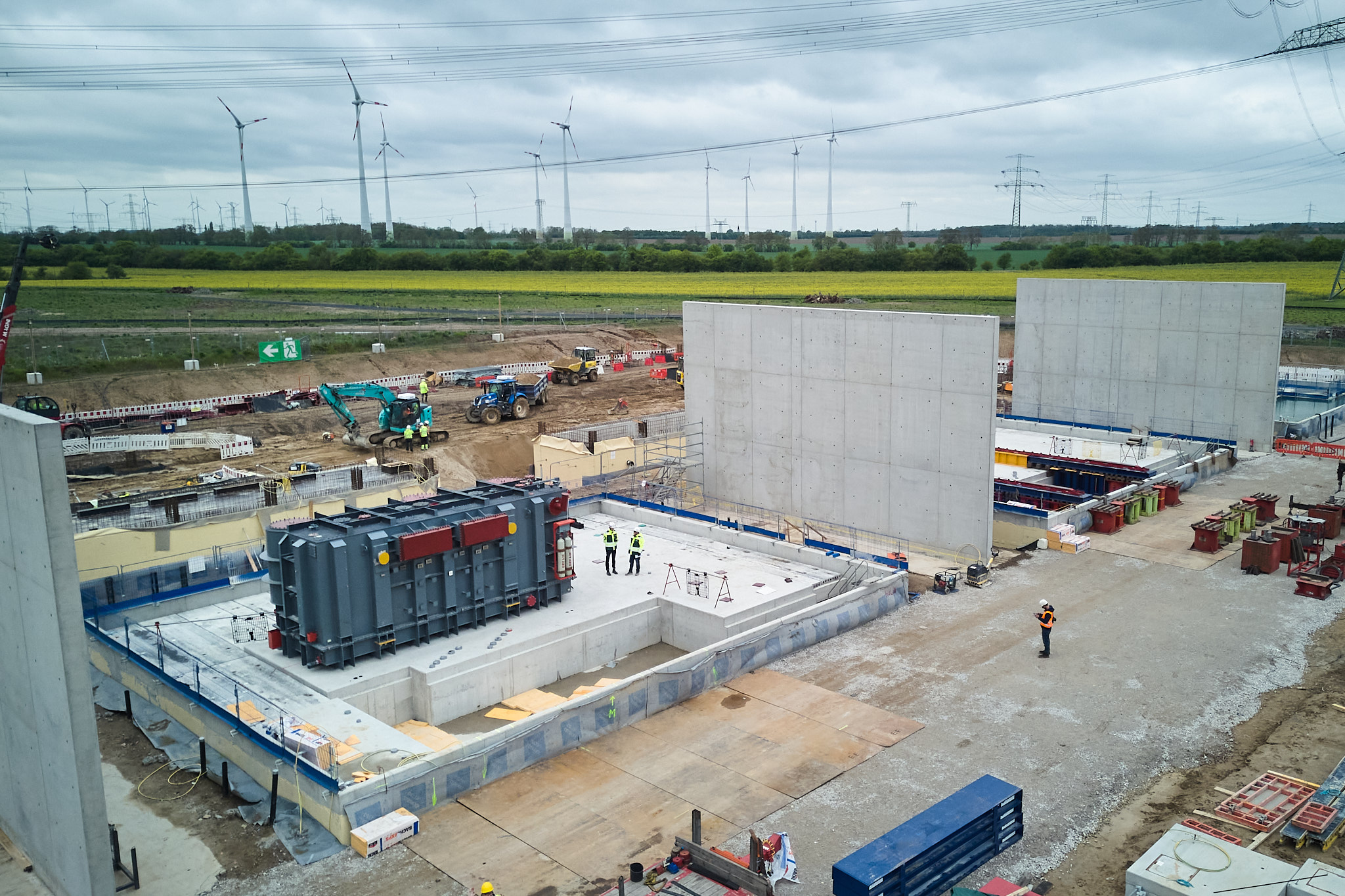
The Wustermark campus is designed around direct connection to the 50Hertz 380 kV transmission network, enabling an initial deployment of 300 MW with future expansion capability scaling to 500 MW.
At the center of the project are two 185 MVA super-grid transformers, among the largest deployed within a European data center environment.
The significance of the project lies not only in its scale, but also in its architecture. By operating at the transmission level, the campus minimizes dependency on local distribution networks, avoiding strain on residential and commercial energy users while improving overall reliability.
The site is also engineered around full 2N electrical redundancy, providing dual independent paths for critical infrastructure systems. Combined with the highest transmission-level connectivity, this creates exceptionally high levels of resilience and availability.
Equally important is the operational flexibility the design enables. While diesel backup generation capability remains available, customers can also pursue a zero-generator strategy supported by the stability of the transmission network and renewable energy integration.
The campus will operate using 100% certified renewable energy, aligning high-performance compute infrastructure with Europe’s long-term decarbonization objectives.
The infrastructure behind the AI economy
The future of AI will depend not only on advances in semiconductors and software, but also on the ability to deliver enormous quantities of reliable, sustainable electricity.
Transformers may not command the same attention as GPUs or AI models, but they are becoming one of the most strategically important components in digital infrastructure.
Projects such as Wustermark demonstrate that it is possible to combine hyperscale growth, operational resilience, and environmental responsibility within a single infrastructure model.
As AI adoption accelerates globally, the operators that master power architecture, transmission-level connectivity, and renewable integration will define the next generation of digital infrastructure leadership.
The transformer, once considered basic utility equipment, is rapidly becoming the backbone of the AI economy.
# # #
About the Author
Mike Golding, SVP Design & Build at VIRTUS Data Centres, leads Design and Construction activities in EMEA. He is a member of the VIRTUS executive leadership team, bringing over 30 years’ experience in the wider construction industry and 20 years of specific data center design and delivery expertise delivering over 750MW of capacity for lease providers and self-build programs of work during this time. Mike is a strong advocate of construction safety, scheduling predictability, sustainability & quality and brings deep experience of end-to-end data center delivery in established and new geo expansions in EMEA.