TL;DR
- How Dr. Ansar’s 15-year research at Oxford led to partnering with Igor Schifrin to co-found Foresight.works and introduce the concept of “time accounting” to match the rigor of financial CFOs.
- A step-by-step breakdown of how a six-month delay on a typical 100MW data center ($1 billion physical build) leads to a $100 million (10%) cost increase in lost revenue, labor, and SLA penalties.
- The platform’s ability to map design geometry to historical project databases, integrate with tools like Procore and Autodesk Construction Cloud, and utilize computer vision to verify progress and surface “bad news” early.
- Dr. Ansar’s outlook on de-biasing project communication, forging professional standards, and implementing AI and robotics to deliver infrastructure worldwide.
# # #
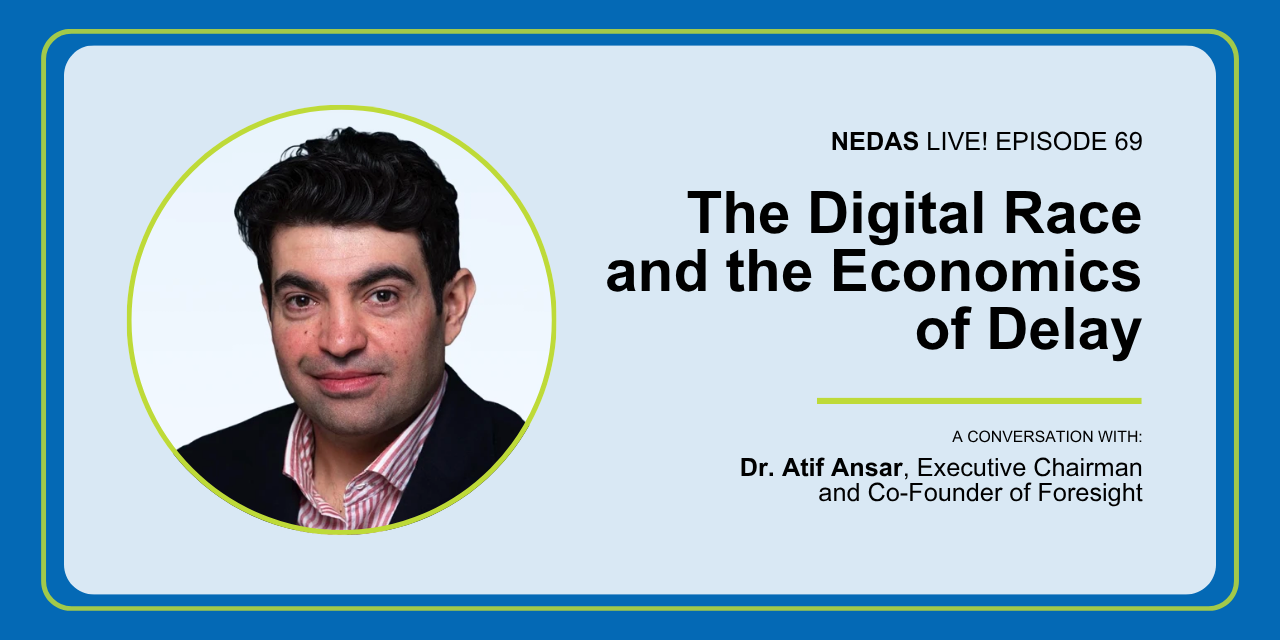
In the latest episode of NEDAS Live!, Episode 69 features a unique perspective on the data center industry with Dr. Atif Ansar, Executive Chairman and Co-Founder of Foresight. NEDAS Live! host, and CEO of iMiller Public Relations, Ilissa Miller explores how Dr. Ansar is redefining how we think about digital infrastructure, project management, and the crucial value of time in the AI-driven world.
Introducing the Chief Time Officer
Dr. Ansar’s journey began at Oxford University, where he spent over 15 years as an academic exploring why megaprojects consistently run late and exceed their budgets. Applying behavioral economics and analyzing large datasets, he uncovered a major blind spot in how organizations deliver large-scale infrastructure.
His research eventually led to a partnership with Igor Schifrin, a developer who had built nearly a million square meters of property around the world and had personally experienced the exact project delivery pain Dr. Ansar had been researching. Igor was attending one of Dr. Ansar’s Oxford executive education courses in 2018 when the two realized they needed to start a business to solve these challenges. Together, they founded Foresight as a way to help CEOs, boards, and organizations achieve greater certainty in budget and schedule delivery.
While organizations bring immense rigor to capital and cost control, time governance is often neglected. Dr. Ansar introduces the concept of the Chief Time Officer (CTO), a role dedicated to establishing standard operating procedures, strategic governance, and valuation metrics for time. Just as CFOs govern money, a Chief Time Officer brings equivalent rigor, diligence, and accountability to a project’s schedule.
Why Time is More Scarce Than Capital
This rebalancing of focus from money to time is particularly urgent for digital infrastructure. Historically, capital was the primary constraint, but today we are in a massive digital race.
Currently, there is over a trillion dollars worth of data centers under construction globally, representing 10% of all global construction, which exceeds both office buildings and retail development. When including the cost of computing chips, the total investment is three times larger. In this high-stakes environment, demand is blistering: data center vacancy rates have compressed to under 1%.
In a world where capital is abundant but time is extremely scarce due to rapid technological obsolescence, speed is the ultimate differentiator. There is no silver medal; you are either first or you are last.
Redefining Strategic Time Governance
Foresight acts as a digital Chief Time Officer, helping developers transition from emotional forecasting to data-driven delivery. The platform ingests data center designs, converts the physical geometry into a structured timeline, and enriches it with the industry’s largest database of past completed data center projects to right-size schedule durations.
Key features of the platform include:
- End-to-End Scheduling: Moving beyond physical construction tasks to account for design, permitting, power, community engagement, commissioning, and other dependencies where delays often emerge.
- Real-Time Progress Verification: Integrating with leading software like Procore and Autodesk Construction Cloud, and using computer vision and cameras to collect objective, on-site evidence.
- Early Warning Insights: Generating real-time insights to highlight risks and surface “bad news” early so developers can proactively address them.
Rather than viewing power and permitting delays as external “surprises,” Foresight helps developers anticipate, plan for, and eliminate these time risks entirely.
Looking Ahead: The Five-Year Vision for World-Class Delivery
When asked what “great delivery” looks like five years from now, Dr. Ansar outlines three key pillars that the industry must work toward:
- De-Biased, Truthful Conversations: Overcoming the cognitive and political biases that lead people to hide delays out of fear. By utilizing data to establish transparency, teams can have honest, constructive discussions.
- Professional Standards: Establishing industry-wide professional standards and codes of conduct for world-class delivery, drawing inspiration from how the medical profession established standards in the 19th century.
- Technological Amplification: Embracing both AI and physical intelligence (robotics) to streamline construction, not to replace jobs, but to make infrastructure delivery faster and more affordable worldwide.
To continue the conversation, listen to the full podcast episode here.