TL;DR
- Enterprise AI procurement should move beyond headline model capabilities to evaluate how the underlying architecture aligns with specific operational workloads.
- Security teams need to trace prompt and document data paths, inspect subcontractor access, and evaluate on-premises or private cloud placement to ensure regulatory compliance.
- Organizations must confirm how vendors manage model updates, pricing adjustments, and behavioral shifts, ensuring teams can retain or retest validated model versions.
- Buyers should secure data export capabilities, prompt portability, and model substitution terms prior to purchase to avoid vendor lock-in as technology evolves.
# # #
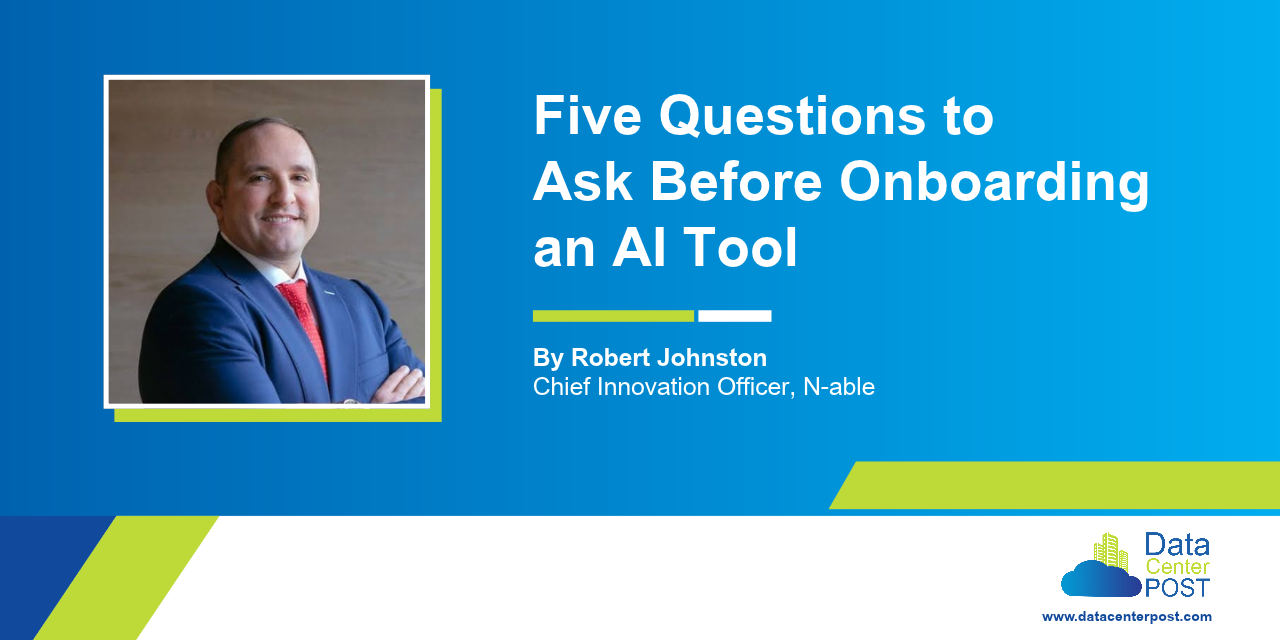
By Robert Johnston, Chief Innovation Officer, N-able
Enterprise AI buying decisions often begin with a familiar set of questions. How capable is the model? How fast is it? What will it cost? Those details matter, but they do not tell an IT or security leader how the product will fit into the organization’s environment.
Before comparing products, define the workload in plain terms. What recurring problem will the tool solve, which data will it need, and what volume should the team expect in production? An AI feature may send data to a third-party provider, rely on a model the customer cannot replace or become far more expensive at real world volume. Leaders can uncover those risks early by asking vendors five practical questions before onboarding a new tool.
What model is actually running underneath the product?
“AI-powered” is a product description, not an architecture. Buyers should know which model or models perform the work, whether they are proprietary or open weight, and why the vendor selected them. They should also ask whether the product uses the same model for every task.
Many enterprise workflows do not require frontier-level reasoning from beginning to end. Understanding which models are used for which tasks helps buyers determine whether the product’s architecture actually matches the workload. Classification, extraction and routing may work well with smaller models, while rules-based software can handle other steps without a model at all. A vendor that has broken the workflow into parts should be able to explain where high end capability is necessary and where it is not. That answer gives buyers a clearer view of cost, performance, resilience, and dependency risk.
Where does our data go?
Ask the vendor to trace the data path during inference and after the response is returned. Where is information processed? Is it stored, logged or used to improve a model? Which subcontractors or model providers can access it, and in what jurisdictions? Existing security controls do not automatically extend to an AI feature simply because it sits inside software the organization already uses.
This review should cover prompts, uploaded documents, retrieved records and model outputs. Source code, service tickets, financial documents and customer records may all contain sensitive information. Security teams need enough detail to decide whether the proposed data flow fits their regulatory obligations, customer agreements and internal policies.
Can sensitive workloads stay inside our environment?
Some workloads are well suited to a vendor-hosted service. Others may need to run in the customer’s cloud tenant, on premises or close to the application that uses them. The right placement depends on the sensitivity of the data, the performance required and the controls the organization must enforce.
Self-hosting doesn’t always mean building a large GPU cluster. Smaller open weight models can run on existing hardware for some tasks, and larger deployments can operate in private cloud or data center environments. Buyers should ask what deployment options the vendor supports, what hardware each option requires and which product features change outside the hosted version. This makes it possible to weigh added control against the cost and operational work of running the model internally.
What happens if the underlying model changes?
AI products can change even when the application interface looks the same. A provider may update a model, retire it or adjust its pricing and terms. Those changes can affect output quality, latency, cost, compliance, and even application behavior. Ask how the vendor evaluates model updates, communicates material changes and tests whether existing workflows still perform as expected.
It is also worth asking whether customers can delay an update or keep a validated model version for a defined period. Organizations in regulated or high-risk settings may need time to retest a workflow before a new model reaches production. The vendor’s answer will show how much control the customer retains after purchase.
What is our exit path?
No organization can predict which model or provider will be the best fit two years from now. New models will emerge, smaller ones will improve and economics will shift. A tool that tightly couples the workflow to one provider can make an otherwise routine change expensive and disruptive.
Before signing, ask whether the model can be substituted without rebuilding the application. Confirm how the organization can export its data, prompts, configurations and evaluation results. Review any license terms that restrict commercial use, redistribution or deployment at scale, especially when a product relies on a model described as open.
A credible vendor should be able to explain the exit path as clearly as the onboarding plan so the buyer understands any dependencies and can accept them deliberately.
Match the architecture to the workload
These questions give procurement, IT and security teams a common way to evaluate AI products. They shift the conversation from a model’s headline capabilities to the practical details that determine whether a tool will remain secure, affordable and useful in production. Successful AI adoption depends as much on understanding dependencies, deployment requirements, and operational ownership as it does on model performance.
The best answer will always vary by workload. What matters is that leaders understand the choice they are making, including where the work runs, how data moves and how easily the organization can change course later if needed.
# # #
About the Author
Robert Johnston is Chief Innovation Officer at N-able, where he leads strategic innovation initiatives across the company’s security services and product portfolio. A seasoned cybersecurity leader and entrepreneur, Robert previously founded and served as CEO of Adlumin, a security operations platform acquired by N-able in 2024. Prior to Adlumin, he served as a principal consultant at CrowdStrike and held cybersecurity leadership roles in the U.S. Marine Corps. He brings extensive expertise in cybersecurity, threat intelligence and emerging technologies, with a focus on driving practical innovation to address evolving security challenges.