TL;DR
- AI infrastructure growth is significantly increasing global data center energy consumption and operational capacity requirements.
- Renewable and carbon-free energy adoption continues to accelerate across hyperscale data centers and colocation environments.
- AI-driven liquid cooling deployments in data centers are increasing industry focus on water consumption, closed-loop cooling systems, and water efficiency strategies.
- Data center operators are making measurable progress in operational efficiency and emissions reduction despite rising AI workloads.
# # #
The rapid expansion of AI infrastructure is reshaping the global data center industry and bringing renewed focus to sustainability, energy consumption, water usage, and operational efficiency. A newly released report from Structure Research takes a closer look at how hyperscalers and data center providers are responding to these growing environmental pressures while continuing to scale infrastructure to support AI-driven demand.
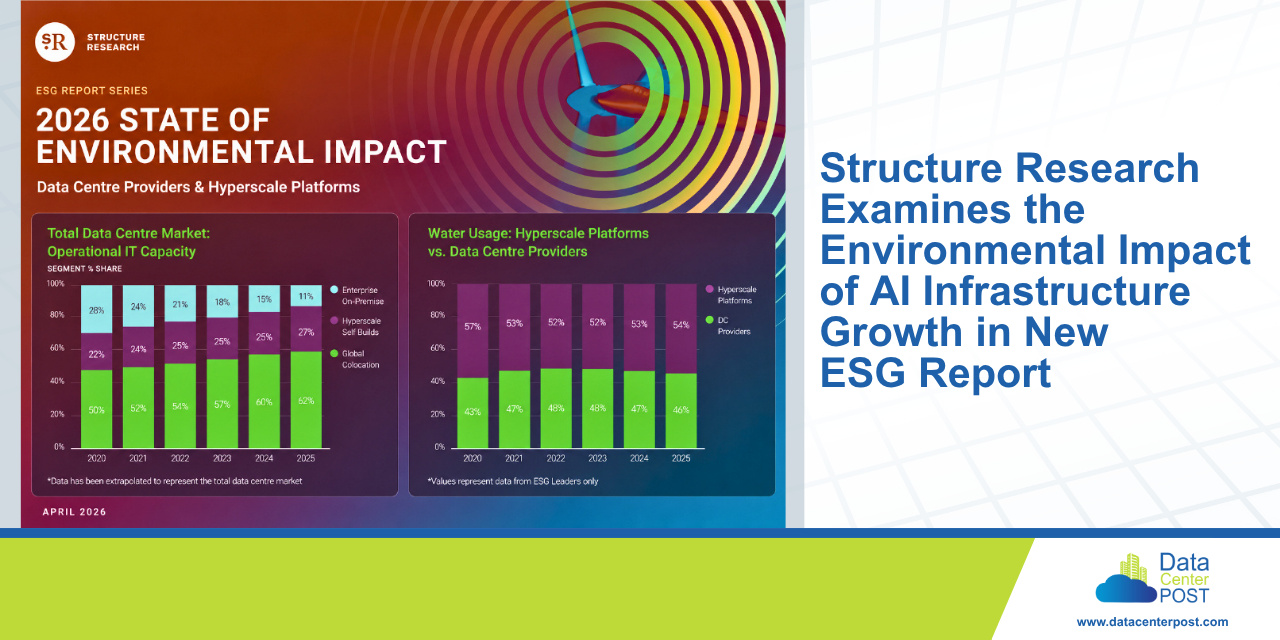
The 2026 State of Environmental Impact Report analyzes environmental data from 38 data center providers and nine hyperscale cloud platforms between 2020 and 2025. The report highlights how AI deployments and high-density compute workloads are accelerating infrastructure growth while also driving new investments in renewable energy, liquid cooling, and operational efficiency.
According to the report, data centers accounted for an estimated 1.23% of global energy consumption in 2025, up from 0.81% in 2020. Total data center energy consumption increased from 198.7 TWh in 2020 to 361.6 TWh in 2025 as hyperscalers and operators expanded capacity to support AI and cloud services.
The report also found that total operational IT capacity within the data center industry reached an estimated 80,242 MW in 2025, compared to 44,046 MW in 2020. Hyperscale self-build capacity grew at a five-year CAGR of 17.6%, reflecting the ongoing global expansion of AI infrastructure campuses and large-scale cloud deployments.
Despite rising resource demands, the report points to measurable progress in sustainability initiatives across the industry. Renewable energy usage among ESG Leaders grew at a five-year CAGR of 26.2%, significantly outpacing overall energy consumption growth. Hyperscalers sourced approximately 92% of their energy usage from carbon-free energy in 2025, while data center providers reached 69%.
As power constraints continue to impact major data center markets, the report notes that operators are increasingly exploring nuclear energy agreements, natural gas partnerships, and direct power procurement strategies to secure long-term energy availability.
Operational efficiency improvements also remain a key focus area. Average Power Usage Effectiveness (PUE) for data center providers improved from 1.44 in 2020 to 1.38 in 2025, while hyperscalers maintained industry-leading average PUEs near 1.21. Emissions intensity also declined during the same period, with average emissions per GWh of energy consumption decreasing from 328.3 mtCO2e/GWh in 2020 to 229.3 mtCO2e/GWh in 2025.
Water consumption emerged as another major theme throughout the report as AI-related liquid cooling deployments continue to expand. Total water consumption among ESG Leaders increased from 55.8 million cubic meters in 2020 to 114.9 million cubic meters in 2025. In response, operators are increasingly adopting closed-loop liquid cooling systems, hybrid cooling designs, and non-potable water strategies to improve water efficiency and reduce environmental impact.
The report also includes the updated Structure Research Sustainability Quadrant (SRSQ), a benchmarking framework designed to evaluate ESG Leaders based on transparency, renewable energy usage, and operational efficiency. The initiative aims to encourage greater consistency and transparency in ESG reporting across the digital infrastructure sector.
As AI infrastructure demand continues to accelerate, the report provides insight into how hyperscalers, colocation providers, enterprises, investors, and policymakers are navigating the environmental realities tied to next-generation digital infrastructure growth.
Read more in the press release and download the report here.