
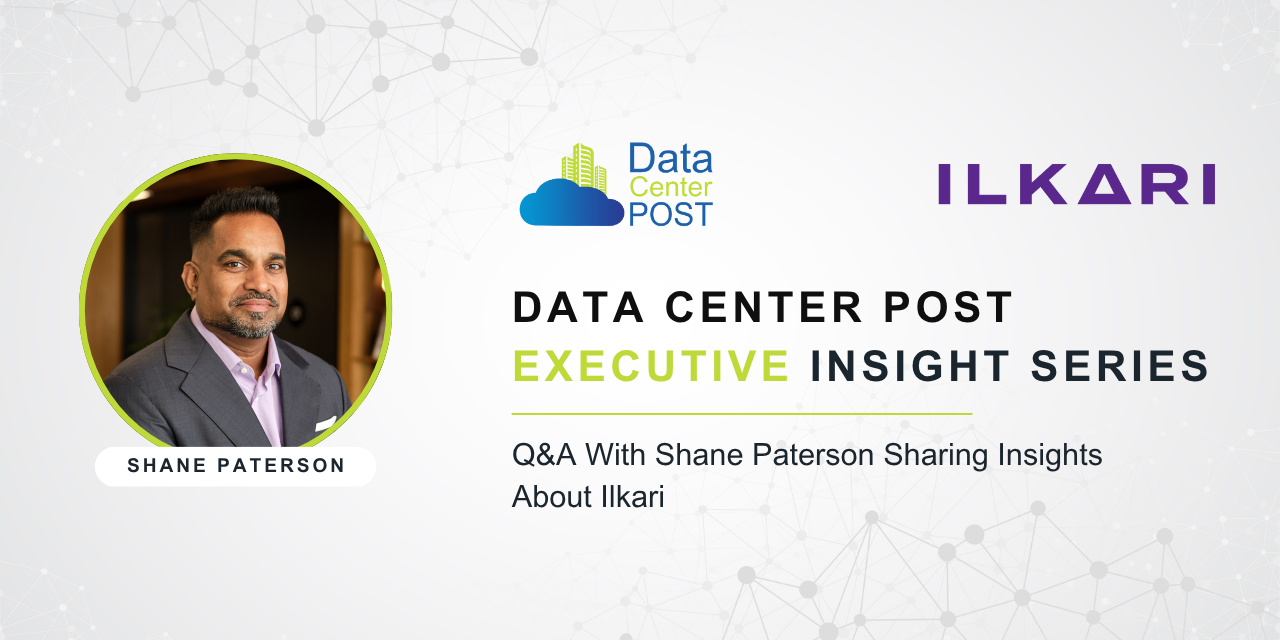
Company Profile: Ilkari’s Vision for a More Resilient, Open Future
Data Center POST recently connected with Shane Paterson, the Founder and CEO of Ilkari. With almost three decades of leadership experience across six countries, he brings a global perspective and extensive expertise to Ilkari’s mission: enabling enterprises to take control of their sensitive data or workloads.
Passionate about tech and not afraid to challenge the status quo, Shane’s background spans IT services, cybersecurity and data centre management, with senior roles at some of the world’s leading technology providers. Starting out as an engineer, he has built a strong track record of delivering complex, high-impact projects throughout Europe, the Nordics, South America, Australia, and South East Asia.
At Ilkari, he combines his technical acumen and strategic leadership to help organizations meet data legislation requirements, reduce operational costs and scale more effectively.
What does Ilkari do?
Ilkari is a sovereign infrastructure provider delivering data centre services, sovereign cloud, and digital infrastructure solutions across Europe, and Latin America.
The company operates certified, high-performance infrastructure environments designed for operational resilience, regulatory alignment, and long-term digital sovereignty, supporting enterprise, regulated-industry, and data-intensive workloads.
Ilkari’s sovereign infrastructure platform spans data centre operations in Iceland, Croatia, and Colombia. Ilkari also operates a premium domain management and digital intelligence platform.
What problems does Ilkari solve in the market?
As a sovereign infrastructure provider delivering data centre services, sovereign cloud, and digital infrastructure solutions across Europe and Latin America, Ilkari helps companies solve the need for secure, compliant, regionally controlled digital infrastructure for enterprises and regulated industries.
What are Ilkari’s core products or services?
llkari operates across three closely connected areas:
- Certified data centre and colocation services, including carrier-neutral connectivity and 24/7 onsite technical support.
- Sovereign cloud infrastructure, delivered through shared and dedicated deployment models.
- Corporate domain name services covering the registration, management and protection of digital identities globally.
Together, these services allow organizations to manage a broader part of their infrastructure through one accountable provider: from their domain portfolio and digital identity to the physical and cloud environments supporting their applications and data.
Our data centre footprint currently spans Colombia, Iceland, and Croatia. This gives customers access to infrastructure across Latin America and Europe, supported by local operational teams and international expertise.
What markets do you serve?
We primarily serve medium-sized and large organizations operating business-critical, regulated or data-intensive environments. These include financial services, government, and public-sector organizations, telcos, healthcare, and technology, as well as digital-first businesses and online platforms managing complex international domain portfolios.
Geographically, our infrastructure platform serves customers across Europe and Latin America, with data centre operations in Croatia, Iceland, and Colombia. Our domain name services have a broader international reach, supporting organizations in managing and protecting their or their customers’ digital identities across global markets.
We are particularly relevant to organizations that need to keep sensitive workloads within a defined jurisdiction, diversify infrastructure across regions or providers, establish business continuity outside a congested primary market, or reassess their dependence on hyperscale cloud and virtualisation vendors.
We also support European organizations seeking to grow or invest in Colombia, and Latin American businesses looking for infrastructure and expertise that can support their international expansion. Our combination of local teams with regional expertise and cross-regional operations allows us to serve as the link between those markets.
What challenges does the global digital infrastructure industry face today?
The industry is facing a collision between rapidly growing demand and increasingly constrained supply.
AI is accelerating infrastructure requirements, but it is arriving at a time when many established data-centre markets are already approaching capacity limits. Suitable land is scarce, grid connections can take years and power constraints are delaying or in some locations effectively freezing further development. According to the IEA, global data-centre electricity consumption increased by 17% in 2025 and is expected to double by 2030, with AI-focused facilities growing considerably faster. That makes access to reliable power one of the industry’s defining constraints.
This growth also has to be sustainable for the communities hosting it. Data centres compete with households and other industries for energy, land, and water. Operators therefore need to demonstrate tangible local value, invest in efficiency and renewable energy, and engage transparently with communities. The industry cannot assume that technical demand automatically creates permission to build.
A second challenge is infrastructure concentration. organizations have gained enormous flexibility from cloud, but many now depend heavily on a small number of hyperscalers, software vendors, and geographic regions. Recent changes in virtualisation licensing and pricing have made this dependency tangible: technology choices made several years ago can suddenly become major cost and operational constraints. For an IT leader, migrating hundreds of virtual machines, applications and data repositories is not a quick procurement decision. Lock-in reduces negotiating power and can make the path to an alternative complex and expensive.
Regulation is adding further pressure. Frameworks such as the EU Digital Operational Resilience Act (DORA) require organizations to look beyond basic compliance and consider operational resilience, ICT third-party risk and concentration across critical providers. These are no longer questions that can be delegated entirely to the IT department; they increasingly affect enterprise risk and board-level decision-making.
This is also why sovereignty is moving into mainstream infrastructure procurement. PwC found that 44% of end users now rank sovereignty and data residency as a leading buying priority; almost level with the 46% prioritising total cost of compute. That tells us customers are no longer evaluating infrastructure on price and performance alone. They also want to know where their workloads reside, which jurisdiction governs them, who can access them and whether they have a credible exit path if their requirements change.
The central challenge is therefore not simply building more capacity. It is building infrastructure that is powerful enough for the next generation of workloads, sustainable enough to retain community support and sufficiently open, resilient and accountable to give customers meaningful control.
How is Ilkari adapting to these challenges?
We are building a multi-region infrastructure platform around four principles: regional capacity with a focus on emerging markets, operational control, customer choice, and sustainability and community impact.
First, we are investing in locations that can offer credible alternatives to the most constrained digital infrastructure hubs. The integration of DC North in Croatia, for example, gives customers access to a fully operational 4 MW carrier-neutral data centre within the European Union, with direct connectivity to internet exchange points in Austria, Hungary, and Slovenia. It adds capacity in a strategically useful location while supporting infrastructure diversification across Central and Eastern Europe.
Second, we combine certified data centres and colocation with a shared and dedicated sovereign cloud. This gives customers more flexibility in deciding where individual workloads should run and how much isolation, control and support they require. A regulated workload may require dedicated infrastructure within a defined jurisdiction, while another application may be better suited to a shared environment. Sovereignty should provide practical choices rather than impose a single architecture.
Third, we recognise that many organizations want to reduce platform dependency but cannot simply redesign their entire technology estate. Our role is to provide a credible alternative and a realistic migration path, supported by local engineers and clear accountability. That is particularly relevant for businesses reassessing virtualisation costs, looking to repatriate selected workloads from hyperscale cloud, or seeking a secondary environment to strengthen resilience.
AI reinforces this strategy. We are not positioning Ilkari as an AI company or applying an “AI-ready” label indiscriminately. Our focus is on the foundations that AI and other data-intensive workloads require: dependable power, resilient facilities, strong connectivity, predictable performance and clear governance over the underlying data.
Fourth, we embed sustainability and community impact into our infrastructure decisions. In Colombia, our facilities operate on a national grid powered predominantly by renewable energy, with hydropower accounting for the majority of generation, and are certified under the SS 564 Green Data Centre standard. In Croatia, DC North achieves a partial PUE (pPUE) of ≤ 1.14, holds an A+ energy-efficiency certificate and is ISO 14001 certified for environmental management. In Iceland, our infrastructure is powered by 100% renewable energy from a mix of hydroelectric power, fed by glacial rivers and melting ice, and geothermal energy from volcanic heat. Across our offices, we run frequent ESG initiatives, including local tree-planting activities, giving back to nature and supporting local communities.
Ultimately, customers should not have to choose between modern infrastructure and meaningful control. Our objective is to give them more choice over where their workloads operate, how their data is governed and which dependencies they are prepared to accept.
What are your company’s key differentiators?
Our principal differentiator is that we approach sovereignty across the infrastructure stack rather than presenting it as a feature attached to one product.
We combine corporate domain name services, certified data centres, colocation, and sovereign cloud. This gives customers a clearer line of accountability, from their digital identity through to the physical and cloud infrastructure supporting their applications and data.
Our geographic strategy is also deliberate. We are not attempting to replicate the scale or footprint of a hyperscaler. We invest selectively in markets where our infrastructure can offer meaningful capacity, connectivity and jurisdictional choice. Croatia, Iceland, and Colombia each provide distinct strategic advantages across Europe and Latin America.
We also combine international expertise with local operational teams. Sovereignty cannot be delivered through contractual language alone. It depends on who operates the infrastructure, who has access to it, who responds when support is required, and whether the customer can reach accountable technical experts.
Finally, we provide a credible alternative for organizations seeking to reduce dependency on large cloud and virtualisation vendors. That does not mean every workload must leave the hyperscalers. It means customers should have genuine options, clearer economics, and a viable path to move or diversify workloads if their requirements change.
What can we expect to see/hear from Ilkari in the future?
Our immediate priority is to deepen the capabilities of the platform we have already established.
In Europe, that means integrating DC North into Ilkari’s wider operations and developing its role as a resilient infrastructure and interconnection hub for Croatia and the wider Central and Eastern European region. We see a clear opportunity to support organizations seeking greater infrastructure diversity and jurisdictional choice within the EU.
Across the business, we will continue developing our sovereign cloud capabilities and the services surrounding them, particularly in areas such as workload migration, security, connectivity, resilience and infrastructure management.
We also expect AI to increase demand for infrastructure that combines scalable capacity with clear jurisdiction, predictable performance and strong data governance. Ilkari will continue developing its data centre and cloud capabilities to support data-intensive workloads in markets where organizations require greater control over how and where their data is processed.
Over time, you can expect Ilkari to establish a presence in additional markets where regulation, data growth and infrastructure concentration are creating demand for credible alternatives. Our expansion will be selective. The objective is not to accumulate locations, but to build a connected platform in which each market serves a clear operational and customer purpose.
What upcoming industry events will you be attending?
Our next major ICT event will be ANDICOM in Cartagena at the beginning of September. Ilkari will exhibit at the event, contribute to its conference programme, and participate as part of the European Union delegation, with the EU joining this year as guest region.
We will showcase our sovereign cloud and certified data centre capabilities while sharing a practical European perspective on sovereign infrastructure with Colombian businesses and government organizations. As a company operating certified data centres across Europe and Colombia, we also have a valuable role to play as a local infrastructure partner for European organizations looking to grow or invest in the Colombian market.
Before then, we will attend Asobancaria’s Banking Convention in Cartagena, which brings together senior leaders from Colombia’s banking and financial-services sector.
Following the integration of DC North, we are expanding our engagement with data centre, cloud and wider ICT communities in Croatia and across Central and Eastern Europe. This will form an important part of our industry programme as we strengthen Ilkari’s regional presence and develop DC North’s role within the European digital infrastructure and ICT ecosystem.
Do you have any recent news you would like us to highlight?
Our most significant recent development is the integration of the data centre DC North in Varaždin, Croatia, into Ilkari’s European operations.
DC North is a fully operational, 4 MW carrier-neutral data centre located approximately 70 kilometres north of Zagreb. It is Croatia’s largest carrier-neutral data centre by operational power capacity and provides connectivity to internet exchange points in Austria, Hungary, and Slovenia.
The integration expands Ilkari’s operational capacity within the European Union and extends our data centre footprint to three markets: Croatia, Iceland, and Colombia. It strengthens our ability to support regulated, sovereignty-focused, and data-intensive organizations across Europe, while providing an additional location for infrastructure diversification and business continuity.
It also creates a foundation for bringing together colocation, connectivity, and sovereign cloud capabilities within an EU jurisdiction.
Earlier this year, we also expanded our infrastructure platform with Ilkari Cloud. Delivered through shared and dedicated deployment models, Ilkari Cloud is designed to provide predictable performance, operational control, and clearer jurisdiction over customer data and workloads. It offers organizations an alternative as they reassess hyperscaler concentration, virtualisation costs and long-term platform dependencies.
Is there anything else you would like our readers to know about Ilkari and capabilities?
Sovereignty is sometimes presented as though organizations must choose between control and innovation. We do not believe that should be the case.
Businesses need infrastructure that performs, scales, and supports technologies such as AI. But they also need to understand the dependencies they are creating and retain meaningful control over their data, providers and operational choices.
Ilkari was established to help close that gap. We are building an alternative for organizations that want modern infrastructure without losing sight of jurisdiction, accountability, or resilience.
We are still a relatively young company, but the foundations are tangible: operational data centres across three markets, sovereign cloud capabilities, an international domain services business, and local teams with substantial infrastructure experience.
Our ambition is straightforward: to give organizations greater control over the digital infrastructure on which they increasingly depend.
Where can our readers learn more about Ilkari?
Readers can learn more about us on our website, ilkari.tech/about. You can also contact us through the contact form on our website.
# # #
About Data Center POST
Data Center POST provides a comprehensive view of the digital infrastructure landscape, delivering industry insights into the global data center ecosystem. As the industry’s only peer-contributed and online publication, we offer relevant information from developers, managers, providers, investors, and trendsetters worldwide.
Data Center POST works hard to get the most current information and thought-provoking ideas most apt to add relevance to the success of the data center industry. Stay informed, visit www.datacenterpost.com.
If you are interested in contributing to Data Center POST, contact us at contributions@datacenterpost.com or submit your article here.
Want more digital infrastructure news? Stay in the know and subscribe to Data Center POST today!

