
TL;DR:
- Green Capital officially advanced Atlas GigaHub with the signing of a Strategic Partnership Agreement in Buenos Aires.
- Planned for up to 3 GW of IT capacity, the project pairs hyperscale AI infrastructure with dedicated renewable energy.
- The milestone highlights a new model for AI infrastructure built through collaboration between government, industry, and energy partners.
# # #
Artificial intelligence is reshaping the digital economy, but the race to deploy AI infrastructure is increasingly constrained by one critical factor: access to reliable, scalable power. As utilities face growing demand, interconnection queues lengthen, and permitting timelines become more complex, developers are reevaluating where and how the next generation of AI infrastructure should be built.
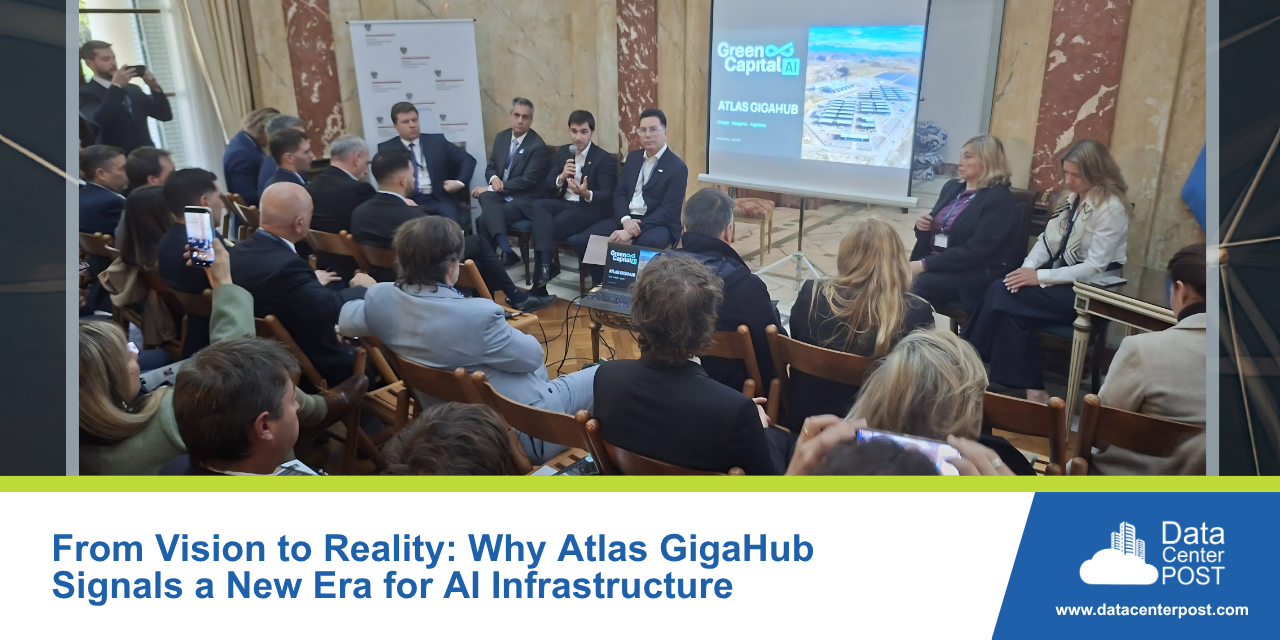
Against this backdrop, Green Capital S.A. (“Green Capital”) recently reached an important milestone in the development of Atlas GigaHub, its planned hyperscale AI infrastructure project in Argentina. During a Strategic Partnership Agreement signing ceremony hosted at the Embassy of the Republic of Poland in Buenos Aires, government leaders, technology companies, energy providers, investors, and industry stakeholders came together to mark the project’s next phase.
While the ceremony celebrated a significant achievement for Atlas GigaHub, it also reflected a broader shift taking place across the digital infrastructure industry. Increasingly, AI infrastructure is moving beyond traditional data center markets toward locations that can deliver abundant renewable energy, long-term power certainty, and room to scale.
A Different Approach to AI Infrastructure
For years, hyperscale development has largely followed established data center markets where network connectivity, cloud ecosystems, and customer demand were already concentrated. Today, however, many of these regions are experiencing mounting pressure from limited grid capacity, rising electricity costs, and increasingly competitive access to power.
Rather than asking where power is currently available, many organizations are beginning to ask where future AI infrastructure can be developed alongside dedicated energy resources. This shift is creating opportunities for regions that combine renewable energy potential, available land, supportive public policy, and the ability to develop large-scale infrastructure from the ground up.
Atlas GigaHub represents one example of this evolving approach.
Planned to support up to 3 GW of IT capacity powered by approximately 10 GW of renewable energy generation, Atlas GigaHub is designed around dedicated micro-grid infrastructure that provides long-term energy reliability while reducing dependence on constrained public transmission networks. By pairing hyperscale data center capacity with renewable energy development, the project aims to create an integrated platform capable of supporting the growing demands of AI workloads.
Argentina’s Opportunity
Argentina offers many of the characteristics becoming increasingly important for next-generation AI infrastructure.
The country offers significant renewable energy resources, vast areas suitable for development, favorable climatic conditions in regions such as Chubut, and growing interest in attracting technology investment. As AI continues driving unprecedented demand for digital infrastructure, these advantages position Argentina to play an increasingly important role in supporting global compute capacity.
During the signing ceremony, Ignacio Torres, Governor of Chubut, noted that this project is a key step in bringing Argentina into the future. His statement reflects more than support for a single development; it highlights the broader economic opportunity associated with attracting advanced digital infrastructure and positioning Argentina within the rapidly expanding global AI ecosystem.
Building an Ecosystem for Gigawatt-Scale Development
Projects of this scale require far more than land and power. Successfully delivering hyperscale AI infrastructure demands expertise across renewable energy generation, electrical systems, engineering, financing, legal frameworks, and digital infrastructure design.
The signing ceremony reflected this collaborative approach, bringing together representatives from Wärtsilä, Schneider Electric, Envision Energy, Ore Energy, Green Capital, government agencies, and investment organizations. Speakers including Green Capital CEO Michał Polanowski, Governor Ignacio Torres, Adam Ryszka of the Embassy of the Republic of Poland in Buenos Aires, and Victoria Castro of PromArgentina highlighted both the scale of the opportunity and the partnerships required to bring it to life. Marta Zlotkowska then outlined the Atlas GigaHub vision before joining an expert panel discussing what it takes to deliver AI infrastructure at scale.
The discussion reinforced an increasingly important reality: delivering next-generation AI infrastructure requires coordinated collaboration across the public and private sectors.
From Concept to Execution
Earlier this year, Green Capital introduced Atlas GigaHub as a new model for hyperscale AI infrastructure, one designed around dedicated renewable energy resources and large-scale deployment rather than traditional grid-dependent expansion.
The Strategic Partnership Agreement represents an important step in transforming that vision into execution.
As AI adoption accelerates, demand for digital infrastructure will continue to expand into regions capable of supporting the power requirements these facilities demand. Success will increasingly depend not only on access to capital and technology, but also on long-term partnerships between governments, infrastructure developers, energy providers, and technology companies.
From Milestone to Momentum
The future of AI infrastructure will not be defined solely by advances in computing technology. It will also be shaped by where reliable, scalable, and sustainable energy can be developed to support that growth.
Atlas GigaHub represents one vision for how that future may unfold, bringing together renewable energy, hyperscale infrastructure, international partnerships, and government collaboration to create a new model for AI development.
As the industry continues searching for ways to deliver capacity faster and more sustainably, projects like Atlas GigaHub illustrate that the next generation of AI infrastructure may emerge in places where power, policy, and long-term vision converge.
See more from the event here.

