TL;DR
- The Midwest AI Boom: A massive 100-Terabit connectivity corridor is being built in the Midwest, which is rapidly becoming a strategic hub for AI infrastructure due to its availability of land, power, and buildable space.
- Symphonic Collaboration: Building such large-scale network infrastructure requires immense trust and deep coordination across service providers, equipment vendors, and operational teams to achieve shared goals.
- Supply Chain and Efficiency: High global demand is creating supply chain bottlenecks for critical networking gear, pushing the industry to focus on smarter transport models that prioritize power and spectral efficiency over pure speed.
- Future Constraints: Moving forward, massive fiber and multi-gigawatt power requirements will be the industry’s biggest hurdles, alongside community permitting resistance. Furthermore, the extreme cost of downtime makes network diversity and resilience an absolute business imperative.
# # #
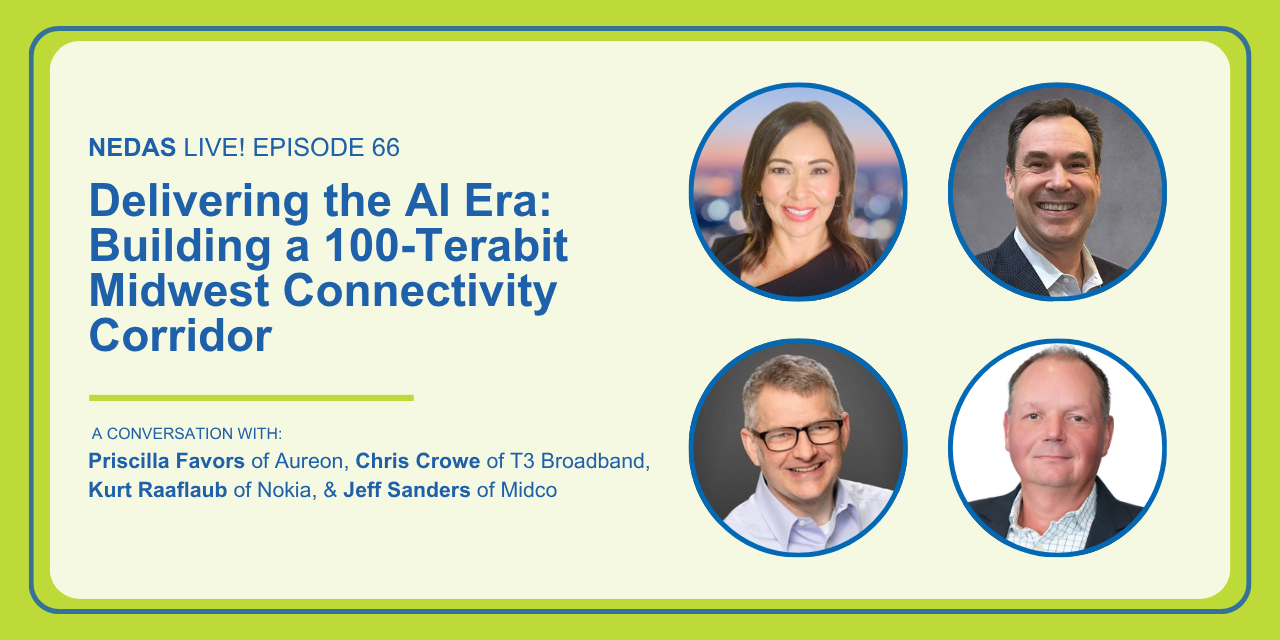
In Episode 66 of the NEDAS Live! Podcast, host Ilissa Miller sits down with Priscilla Favors of Aureon, Chris Crowe of T3 Broadband, Kurt Raaflaub of Nokia, and Jeff Sanders of Midco for a timely conversation about one of the industry’s most coordinated transport builds to date. Centered on the theme “Delivering the AI Era: Building a 100TB Midwest Connectivity Corridor,” the discussion explores why the Midwest is becoming increasingly important to AI infrastructure, and what it takes to bring large-scale network projects like this to life.
As Miller notes, the conversation goes beyond data centers and compute to spotlight the transport layer that makes AI possible. The panel makes clear that none of the AI buildout works without the underlying network infrastructure, or the “nervous system,” as one speaker describes it, that moves massive amounts of data between facilities, regions, and end users.
Why the Midwest, Why Now
One of the most compelling themes in the episode is the Midwest’s rising role in the digital infrastructure landscape. Priscilla Favors explains that the region is benefiting from the growing need for land, power, and buildable space, especially as hyperscale and AI deployments expand beyond traditional coastal markets. What once may have been viewed as secondary territory is now proving to be strategically positioned for the next wave of infrastructure growth.
Chris Crowe adds that the industry is in a period of unprecedented adoption, with demand rising faster than many expected. As AI accelerates, so does the need for connectivity that can support new workloads, new architectures, and new expectations around speed and resilience.
Collaboration at Scale
A major takeaway from the conversation is that projects of this magnitude cannot be executed by one company alone. Jeff Sanders describes the deployment as a symphony, with each participant contributing specialized expertise while staying tightly aligned on the shared goal. From design and fulfillment to construction and interconnection, the build required deep coordination across service providers, equipment vendors, and operational teams.
Favors reinforces that point by emphasizing how critical trust was throughout the process. The work moved quickly, required executive approval at unusual hours, and demanded collaboration across technical, financial, and leadership levels. In her view, the project succeeded because the partners were willing to move together, adapt quickly, and rely on one another’s expertise.
Supply Chain Pressure
The episode also highlights a growing operational challenge across the industry: supply chain constraints. Crowe explains that major and minor components alike can become bottlenecks when global demand spikes. From cabling and shelves to amplifiers and other critical gear, large projects are increasingly impacted by component availability and timing.
Kurt Raaflaub expands on the larger market backdrop, pointing to dramatic increases in data center capital expenditures and the pressure that AI and cloud providers are placing on the broader ecosystem. He notes that regional service providers and integrators are essential to keeping projects moving, especially as the market decentralizes and more connectivity is needed between secondary markets.
Networks Need to Evolve
If the first phase of digital infrastructure was about more bandwidth, the next phase is about efficiency, flexibility, and smarter transport. Raaflaub explains that optical networking is moving beyond pure speed and toward spectral efficiency, lower power consumption, and better cost per bit. In his view, the infrastructure that worked a decade ago is no longer enough for today’s AI-driven requirements.
Sanders echoes that shift, pointing to solutions such as 800-gig wavelength services, managed optical fiber network services, and more adaptable transport models. The era of simply “throwing bandwidth at it” is giving way to a more nuanced approach built around customer needs, geography, diversity, and timing.
Looking Ahead
When asked what the industry may underestimate over the next five years, the panel repeatedly returns to two words: fiber and power. Sanders predicts that intra-building fiber requirements inside AI campuses may become even more massive than many expect, while power demands could escalate toward multi-gigawatt clusters.
Favors adds that land and power availability will remain significant constraints, while also warning that downtime is becoming far too expensive to ignore. She shares that even a single day of outage can cost millions, reinforcing why diversity and resilience are now business imperatives, not just technical preferences.
A Race Defined by Partnerships
The episode closes on a bigger industry truth: AI infrastructure is not just a technical race, but a partnership race. The panel agrees that success will depend on collaboration across suppliers, integrators, service providers, and customers, as well as the ability to educate stakeholders and adapt to changing political, social, and operational realities. Sanders, in particular, warns that community resistance and permitting hurdles may become defining constraints on where AI data centers are built.
As Miller concludes, the industry is at the tip of a much larger transformation, and this Midwest deployment may be just the beginning. With AI demand accelerating and infrastructure expectations changing rapidly, the message from Episode 66 is clear: the next era will be built by those who can move fast, think collaboratively, and deliver at scale.
To continue the conversation, listen to the full episode here.