TL;DR
- The Shift to the Edge: While massive “AI factories” built for model training currently dominate public attention, the real economic transformation of AI will happen at the inference layer or the edge, where capabilities are deployed directly to businesses and public services.
- Beyond Isolated Projects: Communities must move away from evaluating individual hyperscale projects in isolation and instead adopt a layered infrastructure architecture that strategically interconnects centralized compute, regional data centers, connectivity hubs, and edge nodes.
- Long-Term Competitiveness: Infrastructure decisions require a decade-long outlook, as building an aligned, distributed ecosystem today will directly dictate a region’s future workforce development, business attraction, and public service modernization.
- Empowering Local Leadership: To prevent overbuilding centralized capacity and missing out on distributed innovation, municipalities need architectural awareness and strategic frameworks to confidently align their digital infrastructure with local economic, sustainability, and community goals.
# # #
In this seventh article of my series, we can see how industry and government got to where we are today. Even as trust and governance challenges evolve, there is another strategic issue communities must grapple with: understanding that digital infrastructure is not one-dimensional. The current focus on large AI training facilities risks obscuring the broader architectural transformation underway. Long-term competitiveness will depend not just on attracting hyperscale projects, but on planning for layered and distributed infrastructure ecosystems. You can read the previous posts in my series here, to learn more.
Artificial intelligence is accelerating infrastructure development at a pace few communities have experienced before.
Across the United States, large-scale AI training facilities, often described as “AI factories”, are being planned or built to support the next generation of computing demand. These projects are significant in scale, capital intensity, and resource requirements. They are also capturing the majority of public attention.
But they are only one layer of a much larger infrastructure evolution. Due to the lack of a national vision for AI factory development, there is fear that we may be overbuilding AI factories today. And, we have not yet even begun to plan for the inference infrastructure communities will need at the edge.
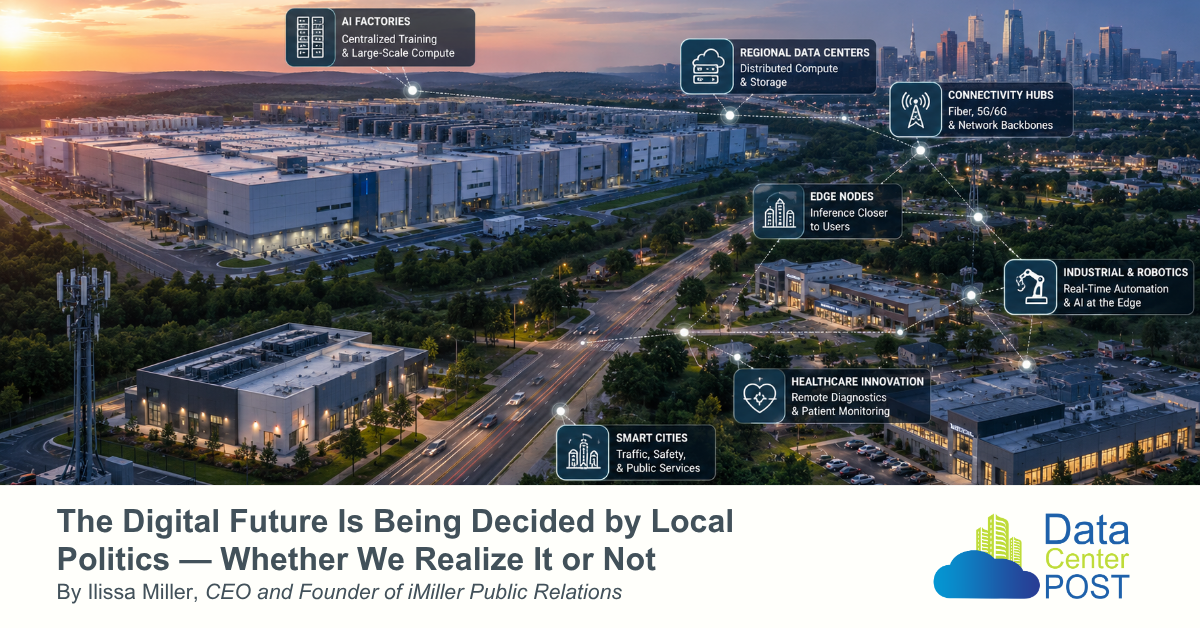
Training facilities represent centralized computers, the environments where massive models are developed and refined. Yet the real economic transformation enabled by artificial intelligence will increasingly occur at the inference layer, or edge, where AI capabilities are deployed closer to businesses, public services, and everyday life.
This shift will require a more distributed infrastructure landscape.
Edge nodes, regional data centers, connectivity hubs, and specialized facilities supporting robotics, healthcare innovation, smart city platforms, and industrial automation will all play a role. Communities that focus exclusively on attracting hyperscale projects without considering how these layers interconnect may find themselves unprepared for the broader digital economy.
Infrastructure strategy, therefore, cannot be defined by individual projects alone.
It must be guided by architecture.
This is particularly important because investment cycles in emerging technologies rarely unfold evenly. Periods of rapid buildout in one segment can create perceptions of overcapacity, while adjacent segments remain underdeveloped. Without holistic planning, regions may overbuild centralized capacity while failing to support distributed innovation ecosystems that ultimately drive sustained economic value.
The time horizon also matters. This is not about the next year or the next project, it’s about where communities will be competitive ten years from now.
Infrastructure decisions made today will influence workforce development, business attraction, real estate markets, and public service modernization for decades. Yet many communities are evaluating proposals in isolation, without frameworks that help them understand how different infrastructure types contribute to long-term economic positioning.
This is one of the reasons strategic planning efforts are becoming increasingly important.
Through the work of the OIX Associations Digital Infrastructure Framework Committee (DIFC), there is growing recognition that municipalities need guidance not only on whether to support development, but on how to think about infrastructure layering, sequencing, and regional coordination.
Digital infrastructure is not monolithic. It is an evolving system of interconnected assets that must be aligned with community priorities, sustainability considerations, and economic aspirations.
Engagement models must evolve alongside this complexity. Helping communities help themselves is the most effective engagement strategy.
When local leaders are equipped with architectural awareness, understanding the relationship between centralized compute, distributed deployment, connectivity networks, and sector-specific applications, they are better positioned to make confident, strategic decisions.
The goal is not to predict exactly how technology adoption will unfold. It is to ensure communities are prepared to participate in that evolution rather than reacting to it.
AI will not reshape only one industry or one region. It will influence how cities operate, how healthcare is delivered, how transportation systems function, and how businesses compete globally.
Communities that adopt a layered infrastructure vision will be better positioned to capture these opportunities.
Those that do not may struggle to keep pace.
Planning for digital infrastructure is no longer just about capacity. It is about architecture.
Learn more about what we are doing at iMiller Public Relations to bridge the gap between industry and community for the digital infrastructure sector, go to www.imillerpr.com.
For information about the OIX DIFC, visit www.oix.org/standards-and-certifications/oix-dif-standard.