TL;DR
- Historical Secrecy Drives Distrust: The digital infrastructure sector has traditionally prioritized confidentiality for valid competitive and security reasons, which inadvertently created a narrative vacuum and fostered public distrust.
- Vulnerability to Misinformation: In the absence of clear, unified communication, complex infrastructure realities are often reduced to emotional, binary debates, allowing polarized media and bad actors to spread misinformation and shape public perception before communities are properly informed.
- The Need for Collaborative Storytelling: Fragmented, independent messaging among developers, utilities, and local officials only reinforces confusion and delays projects. The industry must evolve from reactive silos toward intentional “narrative leadership”.
# # #
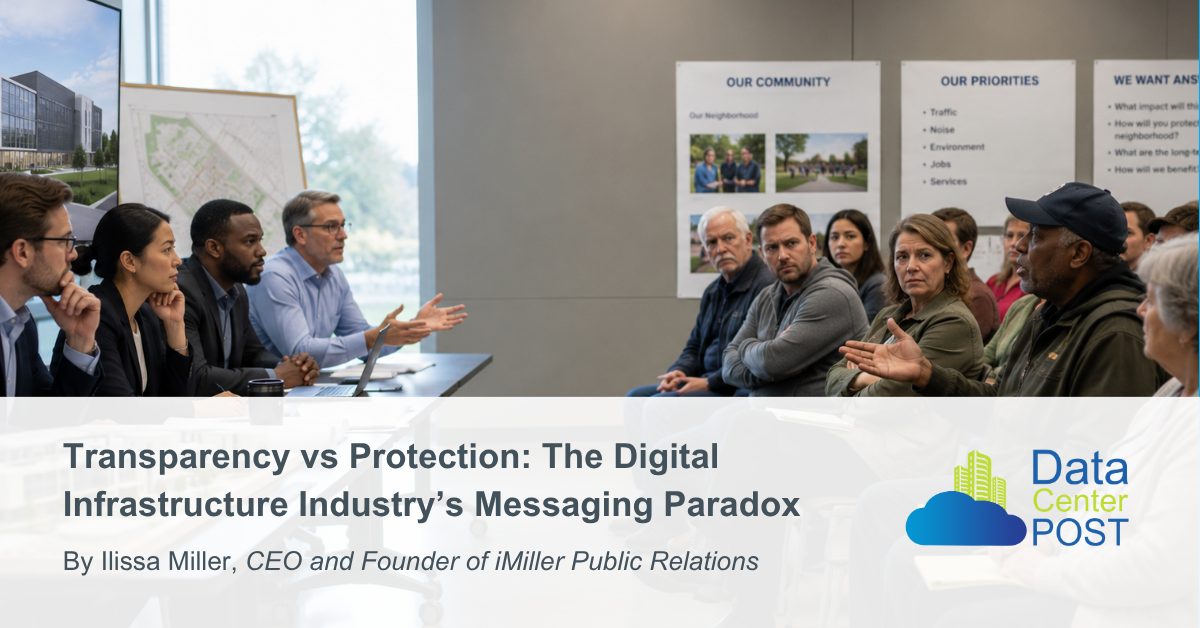
Welcome to article #6 in my eight-part series. As infrastructure decisions move into more visible civic arenas, another dynamic becomes clear: the way the industry has historically communicated, or not communicated, is influencing today’s trust environment. The tension between protecting competitive and security interests while building public understanding has created a messaging paradox that leaders must now navigate more intentionally. You can read the previous posts in my series here, to learn more.
Digital infrastructure has always operated in a complex environment.
On one hand, these facilities underpin financial systems, healthcare delivery, public services, national security operations, and the rapidly expanding AI economy. On the other, they are increasingly visible in local communities: physically, economically, and politically.
For many years, the industry navigated this tension by prioritizing protection.
Projects were often developed under code names. Incentive negotiations took place quietly. Site acquisitions moved quickly. Public education efforts were limited until late in the development process. Messaging varied widely across stakeholders, with each organization advancing its own narrative.
There were valid reasons for this approach.
Competition for land, power, and capital is intense. Security considerations are real. Market timing can determine whether projects succeed or fail. In many cases, confidentiality was not only strategic, it was necessary.
The industry has not done itself any favors. We operated in secrecy for good reasons, but it created distrust. An unintended consequence to connecting the world in secrecy.
In the absence of clear, consistent, and collaborative communication, a narrative vacuum emerged. And narrative vacuums rarely stay empty for long.
Today, misinformation can spread faster than technical clarification. And, with a global race for AI-dominance, global bad actors spreading misinformation can easily derail a nation’s momentum toward dominance. Advocacy groups and polarized media environments often shape public perception before communities have access to balanced information. Complex issues are reduced to binary debates. Emotional framing replaces nuanced understanding.
The paradox we work with is that it’s easy to frame the issues as black and white, but digital infrastructure is complex. It is both necessary and challenging. The uncomfortable middle is where communities are being forced to navigate without guidance and frameworks to empower them toward decisions that, otherwise, could seem uncomfortable.
Infrastructure development brings economic opportunity, innovation, and regional competitiveness. It also raises legitimate questions about sustainability, resource use, and long-term community impact. Holding these realities together requires maturity, from industry leaders, policymakers, and the public alike.
Yet fragmented messaging continues to complicate the landscape. Coupled with emotions such as fear, distrust and a global race for technology (AI) dominance, we’re in a real quagmire here. If we can’t rely on our own truths, whose can we rely on?
Individual developers, utilities, technology firms, and local officials often communicate independently rather than collaboratively. Without shared frameworks or coordinated storytelling, stakeholders can unintentionally reinforce confusion or mistrust. And, that’s not without global interference from others looking to derail the United States’ own national policies.
The result is not just delayed projects. It is a broader erosion of confidence in the processes guiding infrastructure expansion.
This is why we need collaboration. The industry must evolve from reactive communication toward intentional narrative leadership. We cannot solve the digital revolution in silos.
Collaborative storytelling does not mean uniform messaging or suppressing debate. It means aligning around core principles such as: transparency where possible, clarity around trade-offs, and consistent education that empowers communities to engage meaningfully in decision-making.
It also means recognizing that infrastructure conversations are no longer purely technical or transactional. They are civic conversations. They involve identity, economic aspirations, environmental values, and political accountability.
Organizations that can translate complexity into accessible context will play an increasingly important role in shaping how digital infrastructure is understood and evaluated.
At iMiller Public Relations, we often describe this work as narrative architecture. It is not simply about promoting projects. It is about building bridges between industry expertise and community perspective, creating space for informed dialogue rather than polarized reaction.
Digital infrastructure will continue to expand. The question is whether the narratives surrounding that expansion will remain fragmented and reactive; or become collaborative, transparent, and strategically aligned with long-term societal goals.
Trust is not built overnight. But it can be rebuilt intentionally.
Learn more about what we are doing at iMiller Public Relations to bridge the gap between industry and community for the digital infrastructure sector, go to www.imillerpr.com.
For information about the OIX DIFC, visit www.oix.org/standards-and-certifications/oix-dif-standard.