
Industry Analysts Examine Revenue Models, Investment Rationale, and Growth Projections Shaping the Future of Cloud Infrastructure
At the infra/STRUCTURE Summit 2025, held October 15-16 at The Wynn Las Vegas, a distinguished panel of industry analysts gathered to tackle one of the most pressing questions facing the digital infrastructure sector: Is the explosive growth in AI-driven cloud infrastructure sustainable, or are we witnessing an investment bubble destined to burst?
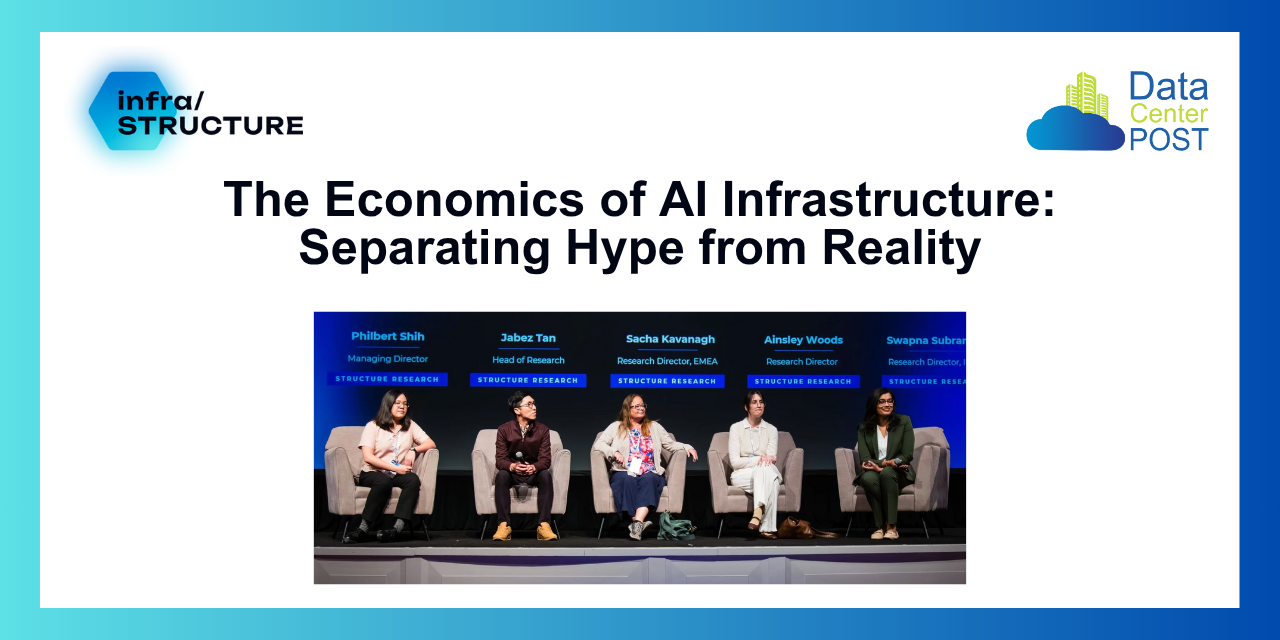
The analyst team conclusion session brought together the Structure Research team to examine the economic fundamentals underpinning today’s unprecedented capital expenditure in AI infrastructure. Moderated by Philbert Shih, Managing Director of Structure Research, the panel featured Jabez Tan, Head of Research; Sacha Kavanagh, Research Director, EMEA; Swapna Subramani, Research Director, IMEA; and Ainsley Woods, Research Director. Together, these experts have been tracking hyperscale investments, cloud infrastructure evolution, and AI revenue generation patterns across global markets.
The Double-Counting Concern: Are AI Revenues Real?
One of the session’s most critical discussions centered on a concern that has been circulating throughout the industry: whether hyperscalers are truly generating new revenue from AI, or simply recycling existing workloads through new pricing models.
“There’s this concern that if off-takers are recycling it or reselling it, and not making money off of that compute, then that’s when I started looking around at the structures,” one analyst explained. “For now, it seems like there is a lot of healthy revenue from very basic off-takers.”
The panel pointed to concrete examples of AI-driven revenue growth. They highlighted Cursor, a development tool that now derives roughly 30% of its revenue through AI capabilities. “If LLMs get to the level of a senior software engineer at Google, just by using all these papers and other resources, there’s real value being created,” the analyst noted.
The consensus: As long as overall net new revenue tied to AI can be measured and we’re still in the very initial stages, the growth is legitimate. “It’s all about recognizing that new revenue,” the analyst emphasized.
Existential Investment: Why Hyperscalers Are Spending “Stupid Amounts of Capital”
The discussion took a fascinating turn when panelists examined the psychology driving hyperscale investment decisions. One analyst posed a revealing question to frame the issue: “If I asked the audience today, how many of you can say with 100% certainty that your jobs will not be displaced by AI, most of us would not be able to say that with 100% certainty.”
This uncertainty, the panel argued, is exactly what’s driving hyperscaler behavior.
“That’s exactly how the hyperscalers feel as well, and that’s why they’re investing stupid amounts of capital because that’s an existential threat to their leadership,” the analyst explained. “They’re not really investing their capex in a purely rational economic framework. They’re investing in it because they don’t want to be the next Cisco.”
This perspective reframes the massive capital expenditure not as irrational exuberance, but as strategic survival. The hyperscalers remember the cautionary tales of technology giants that failed to adapt to paradigm shifts, and they’re determined not to repeat those mistakes.
Cloud as a Delivery Vehicle: Learning from Historical Precedent
To assess the sustainability of current AI infrastructure growth, the panel drew parallels to previous technology transitions. Specifically, Microsoft’s shift from licensing Windows Server to delivering it as a cloud infrastructure service on Azure.
“I view the real clouds that are taking GPUs from Nvidia as a delivery vehicle, a service provider for cloud infrastructure not unlike what Microsoft did with Windows Server,” one analyst explained. “Instead of selling licenses and having customers install software in back offices, they simply delivered it as a cloud infrastructure service off the Azure platform.”
This historical comparison provided the panel with confidence in the current trajectory. However, they acknowledged a critical difference: velocity.
“The Windows Server transition happened over the course of five to ten years and it was slow-moving,” the analyst noted. “What’s happening now moves so fast. That basic velocity at which it happens gives us optimism, but it also makes it harder to predict.”
Projecting Five Years Out: Methodology and Data Points
When asked about revenue projections five years into the future and the data points supporting such tremendous growth, the panel outlined their analytical approach.
“First of all, I’ll say it once again: it’s very difficult to see what’s going to happen,” one analyst acknowledged candidly. “But the methodology is grounded in how we view cloud infrastructure growth historically.”
The team’s approach involves:
- Historical Evidence Analysis: Examining how first-generation cloud and free hyperscale infrastructure evolved, then comparing that to current hyperscale growth patterns.
- Phase-Based Growth Modeling: Dividing growth into distinct phases to understand acceleration patterns and inflection points.
- Fundamental Technology Comparison: Recognizing that “GPU clouds are the same thing, right? Servers with chips and storage.” Building projections on these technological fundamentals.
“When something has no historical precedent, the best way to understand it is to look at the closest analog,” the analyst explained. “That’s how we did it, we built on historical patterns and then tried to say, ‘Okay, this is going to be bigger and faster,’ but it’s based on actual precedent.”
Key Takeaways: Why This Matters for the Industry
The analyst panel’s conclusions carry significant implications for stakeholders across the digital infrastructure ecosystem:
- AI Revenue is Real: Despite concerns about double-counting, evidence suggests genuine net new revenue generation from AI workloads, with companies like Cursor demonstrating meaningful AI-driven revenue streams.
- Investment is Strategic, Not Irrational: Hyperscaler capital expenditure, while massive, reflects existential competitive dynamics rather than speculative excess. Companies are investing to avoid obsolescence.
- Historical Models Provide Guidance: While the current AI infrastructure buildout is unprecedented in scale and speed, previous cloud transitions offer methodological frameworks for understanding and projecting growth.
- Velocity Creates Uncertainty: The rapid pace of change makes prediction challenging, but it also creates opportunities for those who can move quickly and adapt.
- Fundamentals Still Matter: Despite the transformative nature of AI, the underlying infrastructure still consists of servers, chips, and storage—grounding analysis in tangible technological realities.
For infrastructure operators, investors, and technology providers, these insights suggest that while caution is warranted given the pace of change, the fundamental economics of AI infrastructure appear sound. The key will be distinguishing between companies delivering genuine value and those merely riding the hype cycle.
Infra/STRUCTURE 2026: Save the Date
Want to tune in live, receive all presentations, gain access to C-level executives, investors and industry leading research? Then save the date for infra/STRUCTURE 2026 set for October 7-8, 2026 at The Wynn Las Vegas. Pre-Registration for the 2026 event is now open, and you can visit www.infrastructuresummit.io to learn more.

