TL;DR
- While Dallas-Fort Worth is one of the fastest-growing data center markets in North America, colocation vacancy has dropped to an all-time low of 1.8%, and 88% of the 700+ MW currently under construction is pre-leased.
- Hyperscalers dominate the market, structurally excluding mid-market AI operators, regional healthcare systems, and financial firms because developers prioritize multi-megawatt deals and design retail colocation for traditional IT rather than GPU workloads.
- Traditional air-cooling systems fail beyond 30 to 40 kW per rack, whereas modern GPU servers push densities to 80 to 130 kW, making immersion cooling an architectural necessity for next-generation AI workloads.
# # #
Dallas-Fort Worth is one of the largest and fastest-growing data center markets in North America. However, actually securing available space has become nearly impossible. According to CBRE’s latest market data, colocation vacancy in DFW has dropped to an all-time low of 1.8%, and roughly 88% of the more than 700 MW currently under construction is already leased out before it’s even launched.
This market works just fine for hyperscalers and large AI labs. They sign leases years in advance, lock down entire campuses, and negotiate directly with developers and utilities. Meanwhile, the reality for everyone else, including mid-market AI operators, regional healthcare systems, and regulated financial services firms, is completely different as they are structurally excluded.
Excluded by design, not by price
There are three layers working against mid-market buyers in DFW today. One of them is the deal size, as new developments are underwritten around anchor tenants taking tens of megawatts, so a requirement of one to five megawatts rarely gets picked up. On top of that, there’s the timing, with the majority of new supply preleased before groundbreaking, capacity never reaches the open market. And when retail colocation space does become available, it turns out to be largely designed for enterprise IT loads, not for GPU clusters.
“The mid-market has been structurally excluded from the infrastructure buildout happening in DFW. Hyperscalers are building for hyperscale. The minimums are too large, the architecture is shared, and the compliance posture doesn’t hold for regulated industries,” says Dennis Finster, Chief Executive Officer of EG AI Corp. “We built EG AI Corp to close that gap. Single-tenant, immersion-cooled, built specifically for the operator that needs dedicated infrastructure and cannot compromise on data sovereignty.”
The thermal ceiling
That need for dedicated, high-density infrastructure becomes more critical every year. Traditional air-cooled data halls were built to handle racks drawing 5 to 15 kW, and even optimized air-cooling designs will not perform well beyond 30 to 40 kW per rack. The problem is that modern GPU servers push rack densities to 80 to 130 kW, and sometimes even higher.
Immersion cooling offers a solution to this challenge. By submerging servers in a dielectric fluid that transfers heat far more efficiently than air, immersion systems support extreme rack densities while reducing cooling energy consumption, eliminating evaporative water use, and removing the fans and hot-aisle setups that tend to result in both noise and mechanical failure. For companies running continuous AI training or inference, this translates to more compute power per square meter and much more predictable thermal performance.
“Immersion cooling isn’t a feature, it’s an architectural decision that determines what the facility can actually do. Air-cooled environments have a ceiling on rack density that makes them structurally incompatible with next-generation GPU workloads,” says Conrad Eaton, CRO of EG AI Corp. “We designed this facility from the ground up around the thermal and compliance requirements of the operators we’re building for, and that starts with the cooling architecture before anything else goes in the ground.”
The compliance ceiling
For regulated industries like healthcare systems and financial services firms, thermal capacity is not the only obstacle. Frameworks such as HIPAA, GLBA, and PCI DSS require demonstrable control over physical access, audit boundaries, and data environments. In a shared colocation hall, those boundaries are negotiated and documented around other tenants’ operations. For many compliance teams, the complex auditing process outweighs the convenience of shared infrastructure.
Single-tenant architecture solves this problem completely with one tenant, one physical security perimeter, a clean audit boundary, and dedicated power and network paths. Compliance stops being an issue and becomes a property of the building itself.
What purpose-built looks like
A small number of projects are beginning to target this gap in the market. In Dallas, EG AI Corp broke ground in late May on a 5,000-square-meter single-tenant, immersion-cooled GPU data center, with completion targeted for 2027. The facility is being built to directly address the two main bottlenecks: immersion cooling architecture that eliminates the thermal ceiling of air-cooled systems, while the single-tenant model provides complete data isolation, avoiding shared physical infrastructure or third-party data exposure — a structural requirement for HIPAA, SEC, and fintech compliance workloads. It is built specifically for the mid-market operators, healthcare systems, and regulated financial firms the current buildout ignores, and similar single-tenant, high-density models are likely to follow in other supply-constrained markets.
While the industry’s attention is fixed on gigawatt-scale hyperscale campuses, the middle market is where regional hospital networks train diagnostic models, where community financial institutions deploy AI under regulatory scrutiny, and where daily applied AI actually takes place. Meeting that demand will require infrastructure built for it, not whatever is left over.
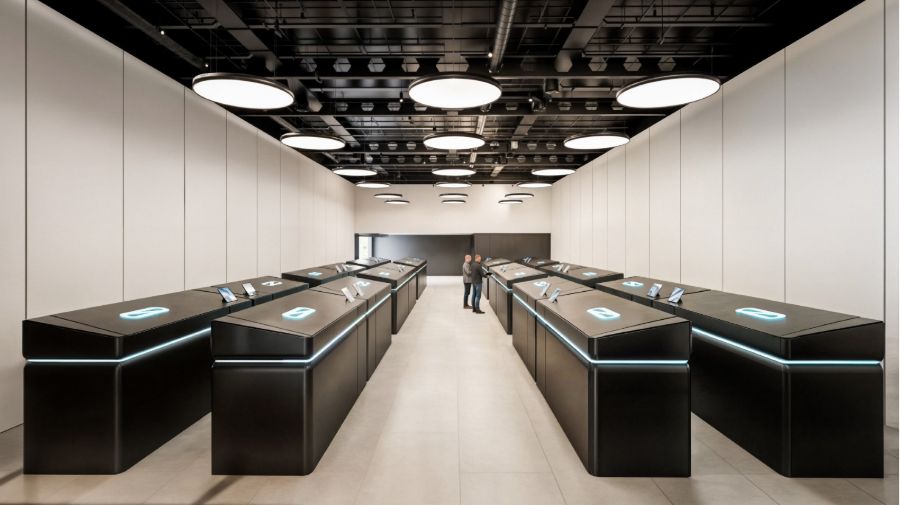
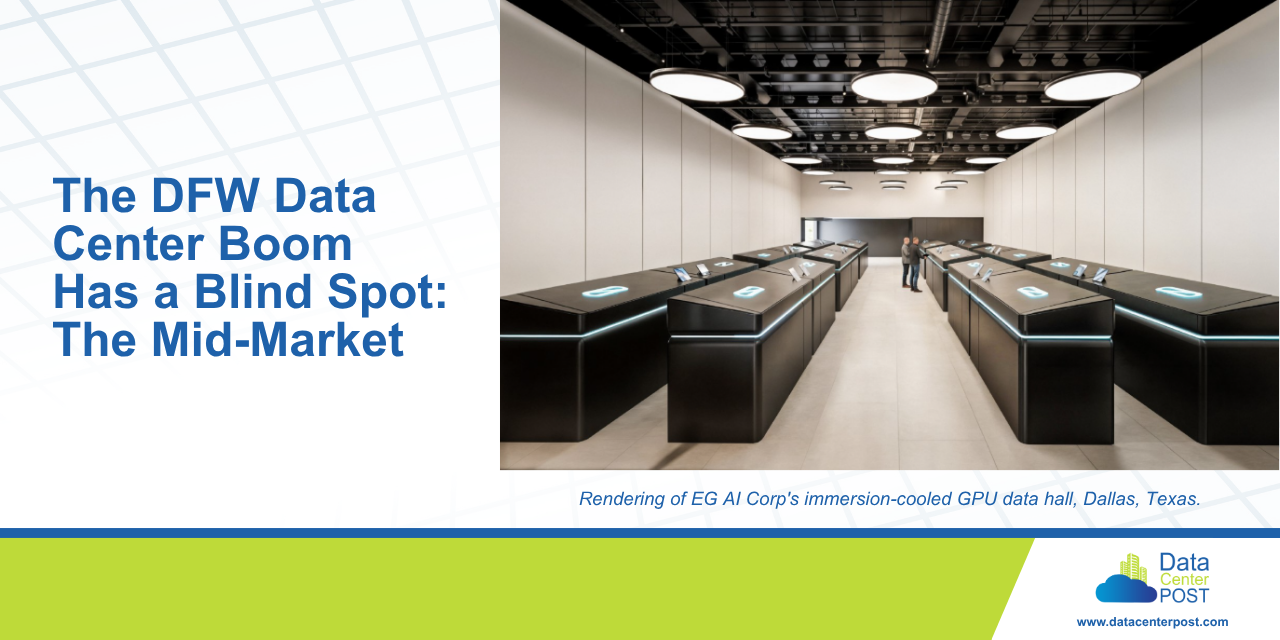
Rendering of EG AI Corp’s immersion-cooled GPU data hall, Dallas, Texas.