
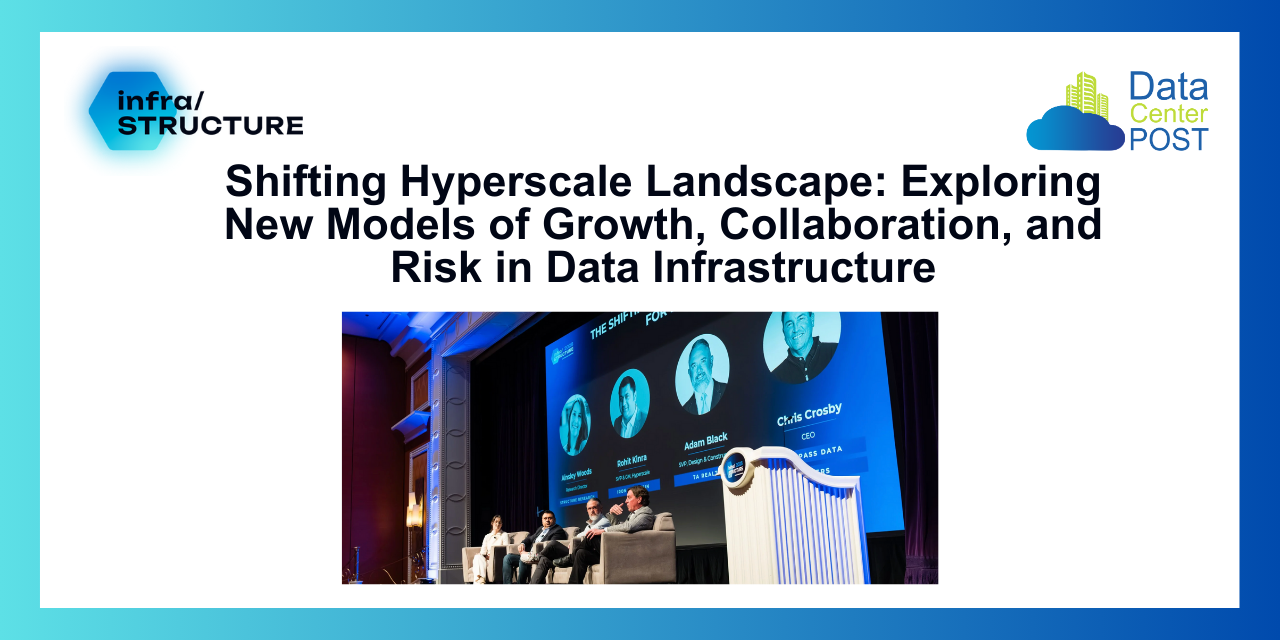
At infra/STRUCTURE 2025, held at The Wynn Las Vegas, industry leaders from Structure Research, Iron Mountain, Compass Datacenters, and TA Realty examined how hyperscales are evolving faster than ever and changing the landscape in data infrastructure.
During the infra/STRUCTURE Summit 2025, held at The Wynn Las Vegas from October 15-16, a panel of industry leaders explored how global hyperscale development models are being transformed by changing procurement dynamics, third-party partnerships, and market-specific constraints.
Moderated by Ainsley Woods, Research Director at Structure Research, the session “Shifting Hyperscale Landscape and Engagement Models” brought together a mix of perspectives from across the ecosystem: Rohit Kinra, Senior Vice President and General Manager of Hyperscale at Iron Mountain; Chris Crosby, CEO of Compass Datacenters; and Adam Black, Senior Vice President of Design and Construction at TA Realty. Together, they discussed how hyperscalers and operators are realigning strategies to manage cost, speed, and risk in an increasingly complex global landscape.
Shifting Toward Third-Party Leasing
Opening the session, Woods noted that while self-build remains a significant approach for hyperscalers, the shift toward third-party leasing continues to accelerate. Kinra explained that this movement reflects a growing appetite to transfer financial and operational risk to providers better equipped to deliver consistent, on-schedule capacity.
“This dynamic enables hyperscalers to focus on core digital capabilities while maintaining agility,” said Kinra.
Crosby observed that data center companies have evolved from highly specialized infrastructure firms into multifunctional operators that behave more like software-driven entities. “The mindset is shifting from ‘construction’ to ‘continuous delivery,’ emphasizing iterative improvement and efficiency at scale.”
Procurement Models and Utility Coordination
Woods directed the discussion toward procurement models, noting “that evolving regulations and nimbyism are materially reshaping project timelines and commitments.”
“Hyperscale leasing can range from single-megawatt tranches to long-term strategic leases, striking a balance between flexibility and guaranteed availability,” said Kinra.
“The necessity of robust collaboration with utilities, pointing out that committed paperwork and confirmed timelines are now prerequisites for greenlighting new projects,” said Crosby. “This transparency and early engagement build trust and ensure that supply chains remain resilient amid rapid scaling.”
Standardization versus Customization
Bringing an engineering and construction perspective, Black said, “The industry is adopting a manufacturing approach to design and delivery. By standardizing components and processes, data center builders are compressing construction cycles, driving down costs, and minimizing rework.”
At the same time, Kinra warned that “flexibility remains crucial, as hyperscalers must frequently adjust designs based on power availability and evolving hardware requirements. Balancing repeatability and adaptability will continue to define long-term competitiveness in global hyperscale markets.”
Partnering for Speed and Scale
When asked whether third-party providers could outperform self-build models, Kinra pointed to overseas examples.
“In high-density Asian markets,” said Kinra, “it’s where leasing has provided a faster and less risky entry point.”
“Experienced operators, especially those with industrial real estate expertise, bring an unlocking function to hyperscalers, helping them secure viable space and navigate permitting challenges,” Crosby underscored.
This is where partners may play a key role in both speed and scale.
“Collaboration, not competition, between hyperscalers and third-party providers will define the next frontier of scale,” said Black. “Flexibility, transparency, and shared accountability are now non-negotiable for long-term partnership success.”
Research, Adaptation, and the Path Forward
In closing, Woods prompted the group for key takeaways. The panelists unanimously emphasized continuous innovation, research, and foresight as the only way to stay aligned with hyperscale’s relentless pace.
“With infrastructure design cycles shortening and technology requirements diversifying,” Kinra concluded, “the winners will be those who can adapt fastest while maintaining reliability and customer focus.”
Infra/STRUCTURE Summit 2026: Save the Date
Want to tune in live, receive all presentations, gain access to C-level executives, investors and/or industry-leading research? Then save the date for infra/STRUCTURE 2026, set for October 7-8, 2026, at The Wynn Las Vegas. Pre-Registration for the 2026 event is now open, and you can visit www.infrastructuresummit.io to learn more.

