
By Anoop Thulaseedas, Associate Director, Solutions & Consulting at Bristlecone.
Industries across technology, semiconductors, infrastructure, energy, and advanced manufacturing are entering a sustained period of structural scarcity. Explosive growth in AI workloads, electrification, defense modernization, and industrial expansion has outpaced the scaling capacity of upstream ecosystems. In this environment, planning models built on forecast accuracy and assumed supply elasticity are no longer sufficient.
Scarcity is increasingly structural in critical industrial ecosystems.
Competitive advantage now depends on recognizing supply constraints as the governing reality of the enterprise. Capacity availability, not demand projection, determines portfolio sequencing, commercial commitments, capital allocation, and revenue timing.
This shift requires rethinking planning itself. Rather than predicting demand and expecting supply to respond, organizations must deliberately govern constrained capacity across interconnected production and deployment layers.
This paper introduces a scarcity-native operating model in which allocation governance, constraint visibility, and cross-layer orchestration replace forecast-centric optimization. While illustrated through AI infrastructure ecosystems, the underlying logic applies broadly across any multi-constraint industrial environment.
Scarcity as a Multi-Constraint Ecosystem
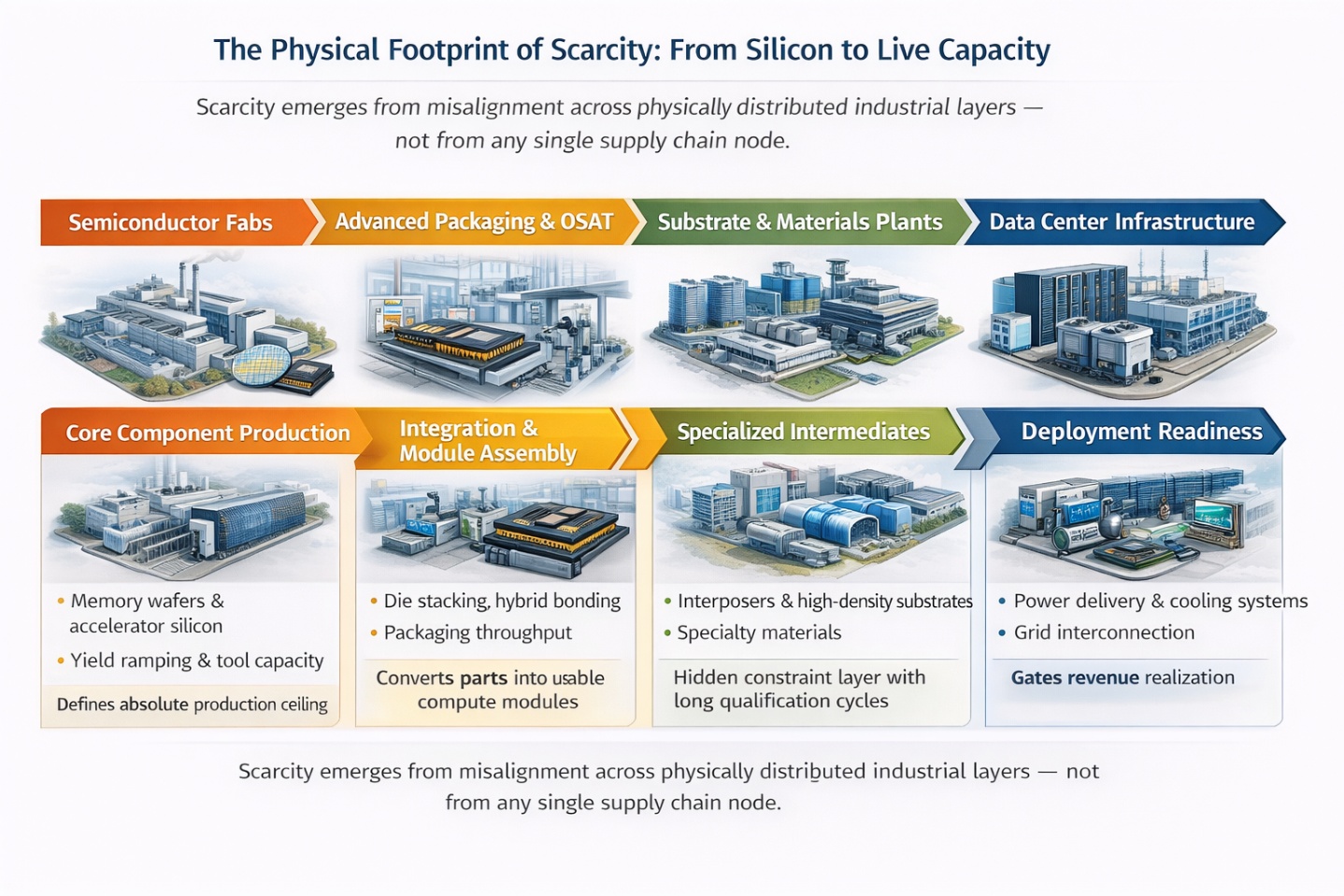
Modern scarcity rarely originates from a single component or isolated bottleneck. Instead, effective supply is governed by a chain of constraints distributed across interconnected production and deployment layers. These layers span geographies, capital cycles, and technical disciplines — from semiconductor fabs to packaging plants, specialty materials facilities, infrastructure sites, and commissioning environments.
Scarcity today is not confined to procurement pipelines or logistics networks. It emerges across an integrated physical system in which each layer possesses independent throughput ceilings, capital intensity, and scaling timelines. Expanding capacity at one node without synchronizing adjacent constraints redistributes bottlenecks downstream.
Scarcity must therefore be understood as a layered physical system rather than an isolated material shortage. While illustrated through semiconductor and data center ecosystems, the same multi-constraint logic applies to energy systems, transportation networks, and advanced manufacturing environments.
The Constraint Chain
Layer 1: Core Component Manufacturing
This layer resides within semiconductor fabrication facilities operated by memory and logic OEMs. It encompasses wafer capacity, yield variability, production allocation decisions, and process throughput limitations. In AI ecosystems, this includes HBM memory production and the output of accelerator silicon. Cleanroom capacity, tool availability, yield ramp maturity and throughput define the production ceiling.
Layer 2: Integration and Advanced Packaging
Following fabrication, components must be integrated into deployable modules within advanced packaging and OSAT facilities. High-precision stacking, bonding technologies, and thermal integration processes convert discrete dies into functional assemblies. Packaging throughput frequently becomes the next gating constraint, independent of wafer supply, due to equipment intensity, cycle-time sensitivity, and specialized labor limitations.
Layer 3: Substrates and Interposers
Specialized substrate and interposer manufacturing is conducted in a limited number of precision materials facilities. These components form the physical interconnect between the compute, memory, and power-delivery layers. Long qualification cycles, limited supplier redundancy, and fine-line manufacturing complexity create structural bottlenecks that often surface only after upstream output expands.
Layer 4: Infrastructure Readiness
Even when integrated hardware is available, deployment depends on the physical site’s readiness. Data center campuses and supporting electrical infrastructure determine installation viability. Rack-level power density, cooling architecture, transformers, switchgear, and grid interconnections govern whether hardware can be activated. These constraints frequently delay monetization despite upstream production success.
Layer 5: Qualification and Commissioning
Final validation, integration testing, and cluster bring-up occur within integration labs and on-site commissioning environments. Skilled engineering capacity, testing infrastructure, and activation throughput determine how quickly deployed assets become operational and revenue-generating.
Orchestrating the Full Constraint System
Optimizing any single layer in isolation produces limited value. Increasing wafer output without packaging capacity, accelerating packaging without infrastructure readiness, or expanding infrastructure without commissioning throughput results in stranded capital and delayed revenue realization.
Value creation depends on synchronized decision-making across the entire constraint chain — from fabrication to live deployment.
Scarcity, therefore, represents an enterprise operating model challenge spanning Planning, Sourcing, Engineering, Infrastructure, and Finance. It cannot be managed as a downstream supply execution issue alone.
Core Differentiators of Scarcity-Native Operating Models
Scarcity-native operating models are defined by structural shifts in how planning is conducted and governed.
1. Scarcity-Native Planning vs Traditional Planning
Illustrative Case: Automotive Semiconductor Reallocation
During the 2020–2022 semiconductor shortage, several automotive manufacturers confronted an immediate collapse of forecast-driven production logic. Rather than waiting for supply normalization, some shifted to allocation-driven governance.
Ford Motor Company provides a clear illustration. With chip supply constrained, the company prioritized high-margin vehicles and new product launches over lower-margin configurations. Production schedules were aligned to confirmed semiconductor availability rather than unconstrained dealer forecasts. Non-essential features were temporarily removed from certain models to maximize yield from scarce components.
The result was not merely damage control. By deliberately allocating constrained inputs toward strategic priorities, Ford expanded its order bank and preserved margin performance in the face of systemic supply tightness.
This behavior reflects entitlement-based baselining and value-optimized deployment sequencing — core characteristics of scarcity-native operating models.
- Entitlement-Based Planning Baselines: Planning begins with confirmed supplier allocations, contracted capacity reservations, infrastructure availability, and commissioning throughput—not unconstrained demand forecasts. These entitlements define deployable reality.
- Allocation-Driven Governance: Explicit allocation logic determines how constrained capacity is distributed across programs, regions, and customers. This replaces reactive firefighting with structured prioritization.
- Value-Optimized Deployment Sequencing: Deployment decisions prioritize revenue realization, utilization efficiency, strategic commitments, and long-term platform positioning — not simply maximizing unit output.
- Continuous Replanning Cadence: Planning operates dynamically. As supplier commitments shift, packaging schedules move, infrastructure readiness evolves, and commissioning throughput fluctuates, allocation decisions are updated in near real time.
In constrained ecosystems, planning becomes less about predicting demand and more about governing capacity.
2. Internal Competition and Portfolio Trade-Off Management
Scarcity does not only constrain external supply. It creates internal competition for limited deployment capacity.
In infrastructure-intensive environments, multiple initiatives frequently compete for the same constrained resources — fabrication allocations, packaging throughput, power envelopes, commissioning capacity, or site readiness. Without centralized governance, these programs generate fragmented demand signals that dilute negotiating leverage, misalign capital sequencing, and create suboptimal capacity utilization.
Scarcity-native organizations formalize portfolio-level prioritization tied explicitly to constrained supply envelopes. Executive trade-off forums align strategic objectives with physical deployment ceilings. Capital investments, infrastructure readiness and customer commitments are sequenced deliberately rather than pursued in parallel under optimistic capacity assumptions.
Allocation decisions are evaluated across explicit dimensions — financial impact, reliability, service performance and long-term strategic positioning — ensuring scarce capacity is deployed where it creates the highest enterprise value rather than the loudest internal demand.
3. Sourcing Embedded Into Planning Decisions
In constrained ecosystems, sourcing cannot function as a downstream procurement activity. It becomes a structural input into planning itself.
Leading organizations embed supplier allocation commitments, capacity reservation agreements and qualification timelines directly into deployment roadmaps. Confirmed supplier envelopes define planning baselines. Tier-2 and Tier-3 visibility informs risk exposure and contingency design. Power equipment lead times and infrastructure component availability are treated as governing constraints rather than execution afterthoughts.
This integration shifts sourcing from transactional purchasing toward capacity governance. Structured forward visibility and commitment mechanisms provide suppliers with the economic rationale to sustain constrained production capability, reducing volatility amplification across the ecosystem.
When sourcing is embedded into planning, deployable capacity becomes a coordinated outcome rather than a negotiated surprise.
4. Engineering as a Practical Scarcity Lever
While many upstream constraints remain outside direct operational control, engineering decisions materially influence how scarcity is absorbed.
Scarcity-native organizations emphasize platform standardization to reduce component fragmentation and dependency on narrow configurations. Design-for-availability principles favor widely supported architectures. Modular infrastructure design enables flexible sequencing of deployment. Qualification of alternate equipment SKUs and suppliers increases interchangeability where feasible.
These choices do not eliminate structural constraints. They expand optionality within them.
Engineering flexibility reduces concentration risk, improves interchangeability and increases the organization’s ability to realign deployment in response to shifting constraint patterns. In constrained environments, architecture decisions become strategic levers of capacity governance.
Short-Term vs. Medium-Term Scarcity Response
Scarcity response requires distinct behaviors across time horizons. Scarcity-native operating models deliberately differentiate between near-term stabilization of constrained capacity and medium-term expansion of structural optionality.
Short-Term (0–90 Days): Stabilize Utilization
- Formal allocation governance across competing programs
- Rapid replanning cycles incorporating real-time supplier signals
- Prioritization of high-value customers and contracted commitments
- Cross-functional executive decision forums
The objective is to absorb volatility without cascading disruption.
Medium-Term (3–12 Months): Expand Optionality
- Supplier diversification and alternate sourcing paths
- Capacity reservation agreements
- Accelerated qualification of alternate SKUs and components
- Platform standardization and modular infrastructure design
- Multi-constraint scenario modeling
The objective shifts from stabilization to structural resilience within constrained ecosystems.
Operationalizing Scarcity Through S&OP and S&OE
Traditional planning architectures separate Sales & Operations Planning (S&OP) from Sales & Operations Execution (S&OE). Under structural scarcity, this separation breaks down.
Instead, S&OP and S&OE function as a closed-loop control system.
S&OP — Policy and Governance
S&OP defines allocation policy:
- Establishes entitlement baselines
- Sets guardrails based on confirmed supply envelopes
- Aligns portfolio priorities with financial and strategic tradeoffs
- Determines how scarcity is distributed across programs and regions
S&OP governs how limited capacity should be used.
S&OE — Dynamic Allocation
S&OE continuously adjusts allocation decisions:
- Reallocates constrained supply as conditions evolve
- Adjusts deployment cadence based on supplier commitments and readiness
- Protects utilization, service levels, and revenue realization
S&OE governs how limited capacity is used today.
The Planning Logic Shift
Traditional logic: Plan → Execute
Scarcity-native logic: Policy → Allocate → Learn → Re-Decide
Execution feedback updates governance decisions. Governance decisions reshape execution priorities. Planning becomes a continuous decision cycle rather than a periodic balancing exercise.
This reframes planning from forecast management into enterprise-level capacity governance.
Conclusion: From Forecast Accuracy to Capacity Governance
Structural scarcity is redefining operational excellence. In constrained ecosystems, supply availability, shaped by interconnected physical bottlenecks, determines what can be delivered, when revenue is realized, and where competitive advantage accrues.
Organizations that succeed are not those that eliminate constraints, but those that govern them deliberately. Scarcity-native operating models shift the enterprise mindset from optimization to orchestration: allocating limited capacity where it creates the greatest strategic and financial impact.
Although illustrated through AI infrastructure, the same logic applies across power systems, advanced manufacturing components, transportation capacity, critical materials, and skilled labor markets. Constraint chains are becoming the defining architecture of modern industry.
The transition to scarcity-native operating models requires deliberate organizational design – from governance structures and measurement frameworks to replanning cadences and cross-functional decision rights. Organizations beginning this journey benefit from structured diagnostic assessments that map current constraint visibility, allocation governance maturity, and planning integration gaps against the target operating model.
In a constrained world, performance is no longer determined by how accurately demand is forecasted. It is determined by how effectively access to limited capacity is governed.

