
How new entrants are reshaping data center operations, capital models, and sustainable development
At the infra/STRUCTURE Summit 2025, held October 15–16 at The Wynn Las Vegas, one of the most engaging conversations explored how a new generation of operators is reshaping the data center landscape.
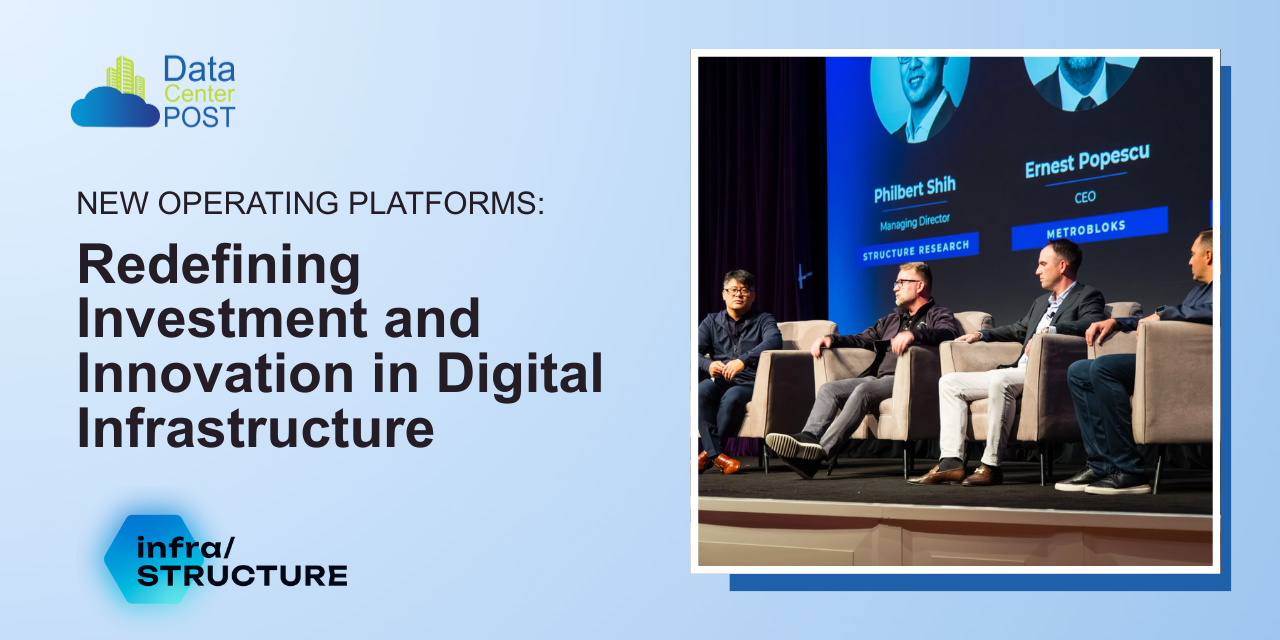
The session, “New Operating Platforms,” moderated by Philbert Shih, Managing Director of Structure Research, brought together executives leading some of the most innovative digital infrastructure ventures: Ernest Popescu, CEO of Metrobloks Data Centers; Eanna Murphy, Founder and CEO of Montera Infrastructure; and Chuck McBride, CEO of Atmosphere Data Centers.
Together, they discussed how new business models, evolving capital structures, and sustainability commitments are redefining what it means to operate in the fast-changing world of digital infrastructure.
Identifying Gaps in a Rapidly Evolving Market
Shih opened the discussion by noting that the surge in investment across digital infrastructure has created room for new operating platforms to emerge.
“The industry has arguably over-indexed on hyperscale and colocation,” Shih said. “But the opportunity now lies in the gaps, in the diverse mix of services, geographies, and market segments that remain underserved.”
He challenged the panelists to explore how their platforms are addressing those gaps, and what kinds of efficiencies or innovations are shaping their approach.
Building for Speed and Efficiency
Murphy described his company’s focus on secondary and emerging markets, areas where demand is strong but infrastructure capacity has lagged.
“We wanted to look at regions where enterprise customers were underserved,” Murphy said. “Our model focuses on connecting Tier 2 cities and surrounding areas, delivering capacity closer to users and creating new connectivity ecosystems.”
Murphy emphasized that Montera’s approach is designed for speed and scale, combining pre-engineered designs and local partnerships to accelerate delivery.
“Even in smaller markets,” Murphy said, “you can build meaningful density if you plan it right and align with community needs.”
Balancing Capital, Capacity, and Time-to-Market
Popescu noted that access to capital remains one of the biggest hurdles for new operators, especially those outside traditional hyperscale markets.
“There’s plenty of opportunity in the market, but capital deployment still comes down to risk tolerance and timing,” Popescu said. “You can’t shortcut power availability, but you can manage time-to-market with flexible models and smart partnerships.”
Metrobloks focuses on developing scalable, self-performable campuses in underserved markets, combining modular design with utility partnerships to bring new capacity online faster.
“It might not be massive by hyperscale standards,” Popescu said. “But for our customers, being able to access distribution power in 12 to 18 months can make all the difference.”
Sustainability and the Next Generation of Infrastructure
For McBride, sustainability and long-term adaptability are at the heart of his company’s strategy.
“We made a conscious choice not to inherit legacy assets,” McBride said. “Instead, we’re building brand-new AI-ready campuses in underserved markets, what we call next-generation training centers.”
Atmosphere’s developments prioritize renewable energy integration and community revitalization. McBride described projects that convert industrial land, such as former power plant sites, into modern digital campuses.
“We’re taking coal-fired sites and turning them into green campuses,” McBride said. “It’s about giving these sites a second life while meeting the demands of AI and high-performance computing.”
Adapting to Changing Technology Cycles
The conversation turned to how operators are preparing for rapid changes in compute and chip technology, particularly as AI drives unprecedented density and cooling requirements.
Murphy noted the growing challenge of aligning long-term infrastructure planning with short hardware cycles.
“Every six months we’re seeing new chip architectures from NVIDIA, AMD, and others,” Murphy said. “But the data center development cycle is still three to five years. The challenge is designing for what’s next without overcommitting to what’s current.”
Panelists agreed that future-proofing is now a key differentiator, with flexibility, modularity, and liquid cooling readiness built into early designs.
Smarter Capital and Better Collaboration
Reflecting on the evolution of the investment landscape, Popescu shared that today’s capital partners are far more informed about the digital infrastructure asset class than even a few years ago.
“Institutional investors have become much more educated,” Popescu said. “The conversations are smarter, and there’s a better understanding of the balance between cost, speed, and sustainability.”
McBride added that hyperscalers, too, have shown greater willingness to adapt pricing and partnership structures in response to development challenges.
“Three years ago, I had never seen the major cloud players react so quickly,” McBride said. “They know developers are essential to getting capacity online, and that alignment benefits everyone.”
The Opportunity Ahead
In closing, Shih reflected on how the emergence of these new operating platforms is reshaping the broader ecosystem.
“We’re watching the rise of operators who are not just building capacity but reimagining how the industry functions,” Shih said. “They’re bridging the gap between capital, sustainability, and innovation, and that’s what will define the next phase of growth.”
As the digital infrastructure industry continues to evolve, these leaders are demonstrating that success now depends as much on creativity and collaboration as it does on capital and construction.
Infra/STRUCTURE 2026: Save the Date
Want to tune in live, receive all presentations, gain access to C-level executives, investors and industry leading research? Then save the date for infra/STRUCTURE 2026 set for October 7-8, 2026 at The Wynn Las Vegas. Pre-Registration for the 2026 event is now open, and you can visit www.infrastructuresummit.io to learn more.

