
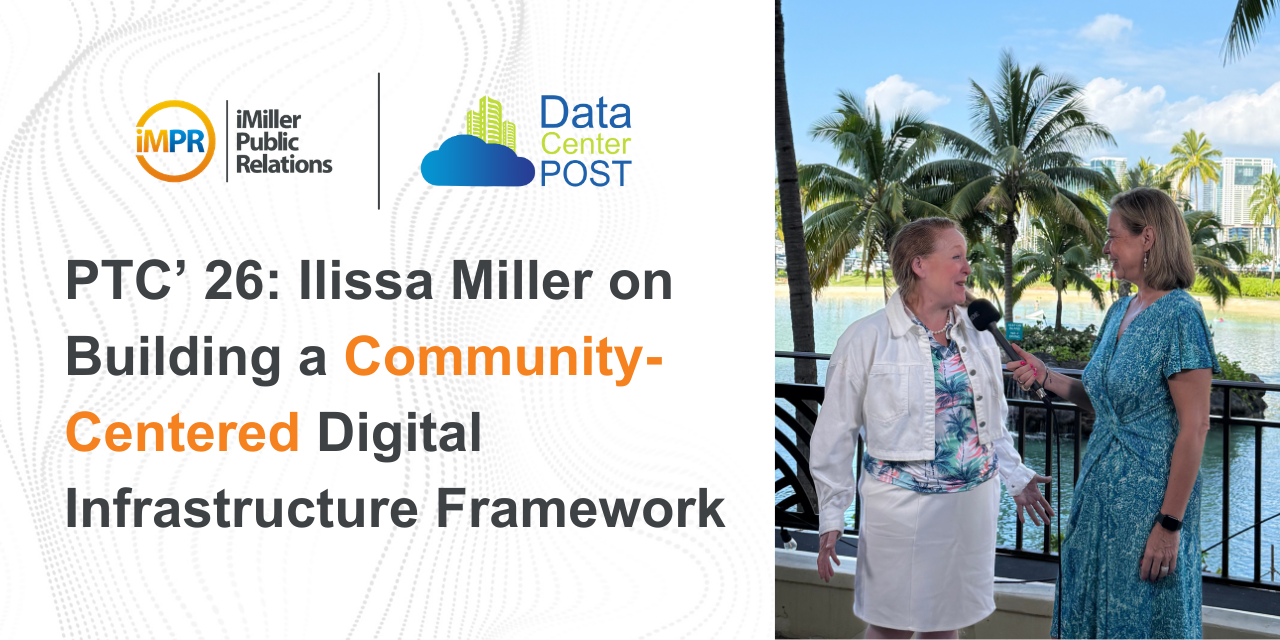
PTC’26 in Honolulu brought together global leaders shaping the future of connectivity and digital infrastructure. Amid conversations about scale, capacity and next-generation networks, one theme stood out: the growing need to align infrastructure development with the communities it serves. Among the event’s luscious backdrop in Hawaii, Ilissa Miller, founder of iMiller Public Relations and editor-in-chief of Data Center POST, shared how that challenge is shaping her work, and a new industry initiative designed to address it head-on – the OIX Digital Infrastructure Framework Committee. Onsite at PTC ’26, Miller spoke with Isabelle Paradis of Hot Telecom to share how communities are navigating the rapid expansion of digital infrastructure and why a more structured planning approach is urgently needed.
As data centers and digital infrastructure projects proliferate, municipalities are increasingly encountering developments that are far more complex than traditional commercial or residential projects. Power requirements, water usage and long-term resource planning often raise questions and concerns at the community level, leading to hesitation or pushback when local leaders lack clear context or planning tools, slowing projects and complicating conversations with the community.
Drawing on 30 years of experience working at the intersection of infrastructure development and public engagement, Miller explained that the challenge is not opposition to technology itself, but uncertainty and change. For example, digital infrastructure developments, such as data centers, do not impact communities in the same way as housing, or even industrial developments. Yet, many municipalities are being asked to evaluate projects without a framework that reflects those differences. That gap, she noted, is where the industry must do more to educate, engage and partner with local decision-makers in order to be effective.
In response, in September 2025 Miller announced the Digital Infrastructure Framework Committee through the OIX Association, a nonprofit organization serving the broader digital infrastructure ecosystem of network, cloud and data center operators. The volunteer-led committee is developing a practical planning framework intended specifically for municipalities and city planners. Rather than reacting to individual project proposals, the framework encourages communities to define a long-term vision for technology infrastructure in their communities, assessing what they have today, what will be required to support governments and businesses tomorrow, and how technology can enable sustainable growth over time.
Miller emphasized that the initiative is built around collaboration and real-world expertise. The committee meets every other week and regularly brings in industry specialists to inform the framework, ensuring it reflects how digital infrastructure is actually designed, financed and deployed. The goal is to deliver a draft to market by early summer, giving municipalities a tangible resource at a time when infrastructure decisions are becoming increasingly consequential.
At PTC’26, where global connectivity, data centers and digital ecosystems take center stage, Miller’s message resonated clearly: the future of digital infrastructure depends not only on innovation and investment, but on trust, transparency and alignment with the communities that host it. By helping municipalities better understand what they are evaluating, initiatives like the Digital Infrastructure Framework aim to move the industry toward a more collaborative, sustainable model for growth.
Save the dates for PTC’27 which will take place in Honolulu, Hawaii from January 17-20, 2027.
You can find the full interview here.

