
How Data Center Developers Are Navigating the Clash Between Rapid AI Demand and Decades-Old Regulatory Frameworks
The data center industry has undergone a seismic shift that would have seemed unthinkable just a few years ago. Historically, operators selected prime real estate locations and then brought power to their facilities. Today, that equation has completely reversed: developers are taking their data centers to wherever power exists, fundamentally reshaping the geographic and strategic landscape of digital infrastructure.
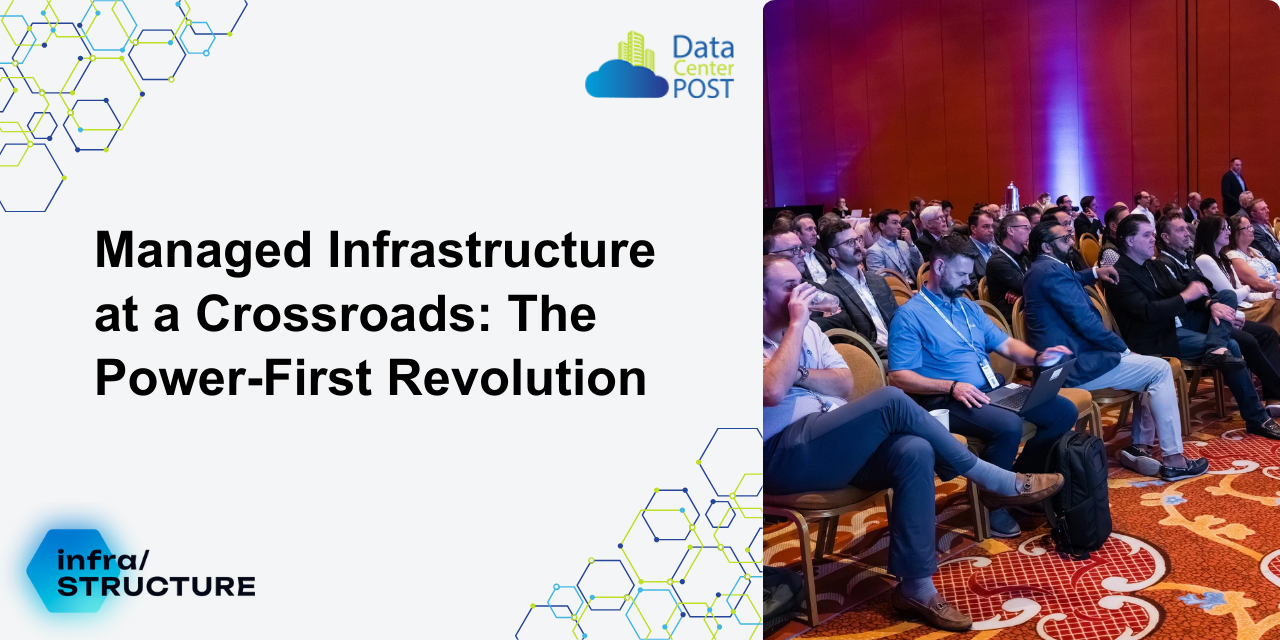
At the infra/STRUCTURE Summit 2025, held October 15-16 at The Wynn Las Vegas, a distinguished panel gathered to explore this transformation and its profound implications. The session “Managed Infrastructure at a Crossroads” brought together experts from across the infrastructure ecosystem to discuss the challenges, opportunities, and regulatory complexities of the power-first era.
Moderated by Hadassa Lutz, Senior Consulting Analyst at Structure Research, the panel featured Gene Alessandrini, SVP of Energy & Location Strategy at CyrusOne; Allison Clements, Partner at ASG (Aspen Strategy Group) and former FERC Commissioner; and David Dorman, Director of Commercial Operations at APR Energy. Together, they examined how the industry is navigating unprecedented demand while working within, and sometimes around, regulatory frameworks that were never designed for this moment.
The 12-Month Transformation: From “Tier One Markets” to “Just Finding Power”
Alessandrini opened the discussion with a striking timeline that captured the industry’s rapid evolution. When he joined CyrusOne just 12 months prior, the focus was squarely on tier-one markets: Northern Virginia, Columbus, and Chicago. Traditional data center hubs with established infrastructure and connectivity.
“Six months into the job, a lot of new secondary markets started popping up, “Alessandrini explained. “Twelve months into the job, it’s like ‘just find power, and then we’ll figure it out.'”
This shift represents more than a change in strategy; it’s a fundamental reimagining of the industry’s priorities. “We really understand that the industry is constrained in the traditional markets, “Alessandrini continued. “Even the new secondary markets are getting tapped out way too quickly. We’ve gone from an industry that focused really on land acquisition with utility interconnection to now, 12 months later, where any source of power is on the table and location requirements are wide open.”
The traditional site selection checklist includes land first, power second, followed by water, workforce, and tax incentives. However, it’s been completely inverted where power is now number one, and land becomes secondary. “Geography is now wide open, “Alessandrini said. “Your decisions on where you’re going to build that next data center really diverge from all the patterns you followed before.”
The trade-off, he noted, is that scale becomes critical. “If you can get scale at that location, you somewhat offset the ecosystem of challenges when you start building data centers in farther-away locations.”
Bridging Solutions: APR Energy’s Rapid Deployment Model
Dorman of APR Energy provided insight into how power generation providers are responding to this urgent demand with innovative, fast-deployment solutions.
“We focus right now on bridging solutions, either a component solution that we can potentially build for a utility or standalone generation,” Dorman explained. “Our lead time from contract to start-up is about 30 to 90 days after receiving permits and everything else. We’re very quick, and what we bring is kind of a fast-to-market approach.”
APR Energy, with over 20 years in the industry, has developed a proven playbook for rapid deployment. Their equipment is scalable, delivered in blocks of 50 megawatts, 150 megawatts, or 300 megawatts depending on site requirements. “The larger the deployment, the more equipment you have, potentially the cheaper the price point,” Dorman additionally noted.
However, even with this rapid deployment capability, there are critical prerequisites. “The assumptions are: you have permits, you have a site that’s a viable site, and you have fuel supply, typically natural gas, connected close to the site,” Dorman said. “If not, there are providers out there that can bridge to a potential connection if there is some development needed.”
The role APR Energy plays is essential in the current environment: providing a bridging solution that fills the gap between immediate demand and the 24-60 months it typically takes for utility-scale generation or permanent solutions to come online.
The Regulatory Reality: A Clash of Cultures and Timelines
Allison Clements, bringing her perspective as a former Federal Energy Regulatory Commission (FERC) commissioner, offered a sobering assessment of the regulatory challenges facing the industry.
“What is fascinating to me is the clash of cultures between the regulated utility industry and the data center development industries,” Clements said. “Data center developers have a real estate background, they’re tech players coming in, they’re used to operating in actual markets with real supply and consumer choice. In the energy world, it just doesn’t work that way.”
Clements described the fundamental mismatch: “You’ve got a regulatory machine and incumbent incentives, and nothing takes less than 30 or 60 or 90 days. There’s this real lack of appreciation and understanding: Why do you have to move so quickly? Why are you moving so slowly?”
Clements emphasized that when data center developers enter the utility space, they’re stepping into one of the most heavily regulated industries in existence. “You might have one, two, or three regulators who have a hand in decisions when it comes to your interconnection, permitting, and water use. The market is trying to move so quickly, and these regulatory frameworks are just trying to catch up.”
Clements message was clear but empathetic: “These utility sectors aren’t dumb. They’re just built into a giant bureaucracy that wasn’t designed to enable the goals that we now have today. That’s true for state regulatory commissions and the Federal Regulatory Commission. We just weren’t set up for this.”
Alessandrini echoed this disconnect from the developer perspective: “Twelve months before I started, I never thought utilities were as separate from our world as you just described. But after living it for 12 months, I realized that our industry is moving much faster than the regulatory framework: utility markets, interconnection, everything is at a slower pace.”
The challenge, Alessandrini explained, is finding ways to bridge this reality gap. “We’re having lots of conversations, trying to bridge the understanding of what our facilities are, what their businesses are, and why we’re unfortunately not moving at the same pace. We’re working together to find ways that relieve pressure on their framework so they can be more comfortable making decisions that allow us to move faster.”
The Utility Incentive Problem: Capital Investment vs. Operational Efficiency
A critical issue the panel addressed was the fundamental structure of utility incentives, a system that may be working against the rapid expansion the industry needs.
“What’s often missed is the perception that utilities are incentivized incorrectly,” Lutz noted, asking the panelists to expand on whether utilities are rewarded more for capital spending than for optimization and efficiency.
Clements confirmed this concern is rooted in reality. “You have a regulatory system where the incumbent utilities have been given the franchise right to be a monopoly, and they make money by one: volumetric sales, so the more electrons they sell, the more money they make, and two: by capital investment, steel in the ground, generation or grid.”
This creates a structural problem: “A lot of times, efficient operations and opportunities like buying behind-the-meter generation don’t align with the utility business model.”
Dorman, drawing on his 13 years as a utility executive before moving to generation, offered a particularly insightful observation: “It’s funny we’re sitting here saying utilities want to invest in their rate base because that becomes their revenue stream. Yet now the behavior I know it’s not their intention but the way it appears is you don’t want the load anymore, so your rate base doesn’t grow. The new tariff structures appear to disincentivize load growth rather than incentivize it.”
This paradox sits at the heart of the industry’s current challenges: utilities structured to profit from capital investment and volume sales are implementing tariffs that may discourage the very load growth that should benefit them.
Cost Allocation: The Political Third Rail
Clements addressed one of the most politically sensitive issues facing the industry: who pays for what when data centers connect to the grid.
“Data center markets have come onto the system at rapid-fire pace in a moment where electricity prices were already rising,” Clements explained. “The grid has been underinvested in for a long time.”
She outlined three types of costs:
- Direct interconnection costs: the physical connection to the grid
- Indirect grid impact costs: taking up space on the grid that might impact economic constraints elsewhere
- The cost of the electron itself: the actual generation cost
“There’s a lot of discussion around cost allocation,” Clements said. “Data centers come in saying ‘we want to pay our fair share,’ and they do pay for direct costs like substations or switching circuits. But what they don’t pay for is residential customer increases in electricity prices or broader transmission development.”
Clements was careful to note this isn’t necessarily unfair, it’s how supply and demand markets are supposed to work. “You have new customers, new supply should come in, and it should all work out. The opportunity for data centers to lower costs is tremendous.”
The problem, she explained, is timing. “The underlying regulatory frameworks haven’t kept up. As a result, you see demand increasing and supply tightening because we haven’t had time for new supply to come in. These rising costs have been in some part because of data centers, but in large part were coming regardless.”
The political pressure is mounting. “Data center opposition is growing up in communities around the country,” Clements warned. “These are real people with cost concerns, and we need to take it seriously.”
The Scale of the Challenge: 128 Gigawatts by 2029
To put the industry’s challenge in perspective, Clements shared a sobering statistic: “The lowest forecast suggests we’ll have 128 new gigawatts of power demand for data centers. That’s the amount of power it takes to power the entire mid-Atlantic region, that includes Philadelphia, Washington D.C., and Chicago.”
Clements was blunt about the timeline constraints: “If you want power by Q4 2029 and you start today, you can’t build a lifecycle gas plant in that time. Maybe, if you’re lucky enough to secure modular equipment and you start procurement today, in 18 months you can have a solution.”
This reality is driving the search for alternatives and interim solutions, everything from bridging generation to demand flexibility to grid optimization technologies.
Being a “Good Citizen”: Beyond Just Big Power Solutions
When asked what it means to be a “good citizen” in this environment, the panelists emphasized the need for data center operators to look beyond simple power procurement.
Clements urged the industry to embrace innovation: “The hyperscalers want these innovative solutions. Think about opportunities beyond just the big power solutions. There’s hardware and software that helps run the grid more dynamically. We still run our grid like it’s in the 1980s era, no joke in the US.”
Clements also highlighted demand flexibility as a critical tool: “Data centers actually committing to some sort of proactive curtailment throughout the year. That’s hard, it might involve going offline for periods. There are trade-offs in each of these approaches, and each one introduces different risks into your transaction that may or may not be desirable.”
The panel also addressed community impact. “There’s a lot of opportunity for smart developers to give back to the community,” Clements said. “Fire stations, education, public services, these investments matter. We need to help communities understand which part of their electricity bills data centers are responsible for and what they’re doing to mitigate that impact.”
The New Geographic Reality: Data Centers in Unexpected Places
Alessandrini painted a picture of the industry’s evolving geography. “We’re possibly creating new markets for data centers because we’re taking data centers to places you’ve never seen before, the outskirts of Texas, Alabama, Wyoming, and all these other areas.”
This geographic expansion isn’t without challenges. These regions often lack the established ecosystems, workforce, connectivity, and supply chains that traditional markets offer. But when balanced against the availability of power at scale, the trade-offs become acceptable.
“The reality is the industry will continue to broaden,” Alessandrini said. “Power solutions will come from locations with access to gas supply that historically weren’t considered data center markets.”
The 24-to-60-Month Gap: A Bridge Too Far?
Perhaps the session’s most critical tension was captured in Alessandrini’s assessment of timeline misalignment.
“What I realized 12 months in is that instead of being more comfortable that the gap was closing, the gap is actually widening,” Alessandrini said. “We have a 24-month timeline to get facilities built and operational. The regulatory and utility side operates on a 36-to-60-month timeline.”
He was emphatic about the industry’s position: “We’re going to be there in 24 months, and you just tell us when you can join the party, whether that’s 60 months or 72 months. But guess what? We’re going to be there in 24 months.”
The question facing the industry is how to bridge this gap. “We’re going to build power plants, we’re going to build bridging solutions, we’re going to build all these things to allow data centers to get built based on the velocity of our industry,” Alessandrini said.
Dorman agreed: “If we can solve the problems as an industry and bring that 60 months down to 36 months, we still have this 24-month target that we just can’t let go of. We’re going to keep building.”
Looking Ahead: Nuclear, SMRs, and Long-Term Solutions
While the session focused heavily on near-term challenges and natural gas solutions, the panelists acknowledged that longer-term answers may include nuclear power and Small Modular Reactors (SMRs).
“The new SMRs are something which can come to market too,” Alessandrini noted. “We’re trying to wrap our heads around the new reality of data centers today and possibly creating new markets, including with emerging nuclear technologies.”
However, the timeline for commercialized SMR technology remains uncertain, making bridging solutions and interim approaches all the more critical.
Key Takeaways: Navigating the Power-First Era
The panel’s discussion revealed several critical insights for the data center industry:
- Power Has Become the Primary Site Selection Criterion: The traditional real estate-first approach is dead. Geography is now determined by power availability at scale, fundamentally reshaping the data center map.
- The Regulatory-Developer Timeline Gap Is Widening: Developers operate on 24-month cycles; regulators and utilities on 36-60-month cycles. This gap isn’t closing, it’s growing, forcing creative bridging solutions.
- Utility Incentive Structures Are Misaligned: Current regulatory frameworks reward utilities for capital investment and volumetric sales, which may not align with the rapid, efficient expansion the industry needs.
- Cost Allocation Is a Political Powder Keg: As residential electricity bills rise and data center development accelerates, community opposition is growing. The industry must proactively address cost concerns and community impact.
- Bridging Solutions Are Essential: With demand far outpacing utility-scale generation timelines, fast-deployment bridging solutions from providers like APR Energy are critical to keeping projects on track.
- Being a Good Citizen Requires More Than Paying Bills: Data center operators must embrace demand flexibility, support community initiatives, and invest in grid optimization technologies, not just consume power.
- The Scale Is Unprecedented: Meeting 128 gigawatts of new demand by 2029 will require every tool in the toolbox, traditional generation, bridging solutions, demand management, grid optimization, and potentially nuclear.
- Secondary and Tertiary Markets Are the New Frontier: Texas, Alabama, Wyoming, and other historically non-traditional data center locations are becoming viable, even preferred, due to power availability.
For operators, investors, policymakers, and community stakeholders, the message is clear: the data center industry is at an inflection point. The power-first revolution isn’t a temporary adjustment, it’s the new normal. Success will require unprecedented collaboration between developers, utilities, regulators, and communities to bridge the gap between digital infrastructure’s breakneck pace and the energy sector’s deliberate timelines.
As Alessandrini concluded: “This is a dynamic industry to be in. We’re going to keep building, we’re going to keep finding solutions, because the demand isn’t going away, it’s only accelerating.”
Infra/STRUCTURE 2026: Save the Date
Want to tune in live, receive all presentations, gain access to C-level executives, investors and industry leading research? Then save the date for infra/STRUCTURE 2026 set for October 7-8, 2026 at The Wynn Las Vegas. Pre-Registration for the 2026 event is now open, and you can visit www.infrastructuresummit.io to learn more.

