
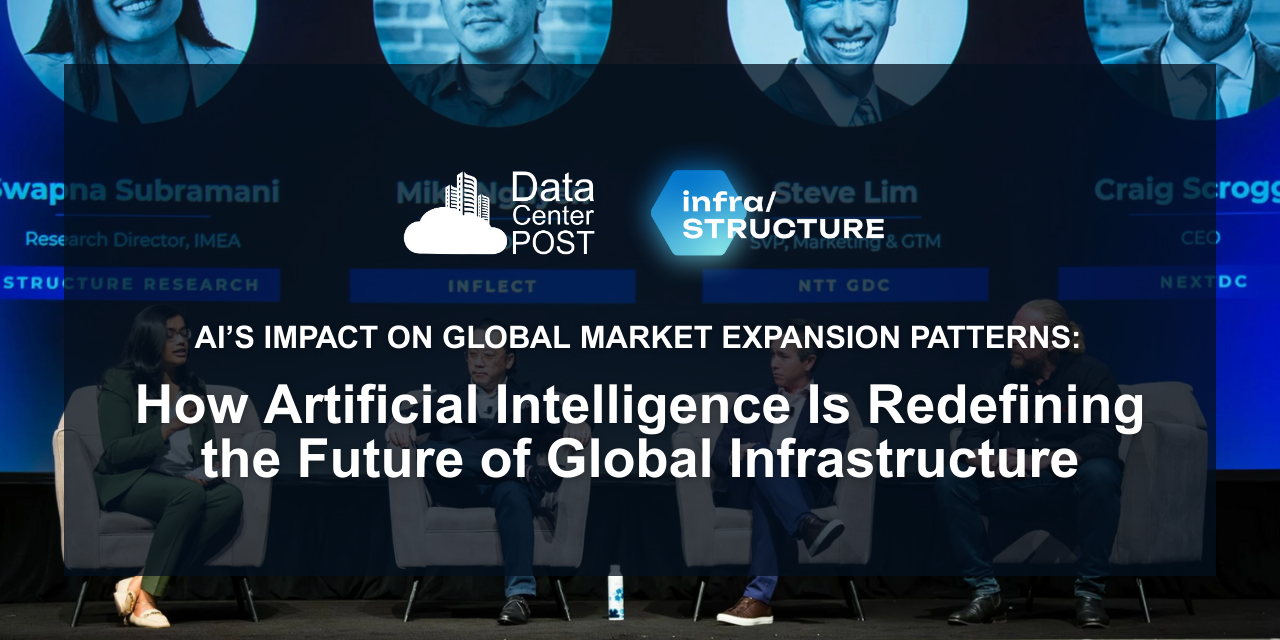
At infra/STRUCTURE Summit 2025, industry leaders from Inflect, NTT and NextDC explored how AI is accelerating development timelines, reshaping deal structures, and redrawing the global data center map.
The infra/STRUCTURE Summit 2025, held at The Wynn Las Vegas from October 15–16, 2025 convened the brightest minds in digital infrastructure to explore the seismic shifts underway in the age of artificial intelligence. Among the most forward-looking sessions was “AI Impact on Global Market Expansion Patterns,” a discussion that unpacked how AI is transforming where and how data centers are developed, financed, and operated worldwide.
Moderated by Swapna Subramani, Research Director, IMEA, for Structure Research, the panel featured leading executives including Mike Nguyen, CEO, Inflect; Steve Lim, SVP, Marketing & GTM, NTT Global Data Centers; Craig Scroggie, CEO and Managing Director, NEXTDC. Together, they examined how the explosive demand for AI compute power is pushing developers to rethink long-held assumptions about geography, energy, and risk.
AI Is Rewriting the Rules of Global Expansion
For decades, site selection decisions revolved around a handful of core variables: power cost, connectivity, and proximity to major user populations. But in 2025, those rules are being rewritten by the unprecedented scale of AI workloads.
Regions once considered secondary are suddenly front-runners. Scroggie noted how saturation in markets like Singapore and Hong Kong has forced expansion across Thailand, Indonesia, Malaysia, and India, each now racing to deliver power, land, and permitting capacity fast enough to attract global hyperscalers.
“You can’t build large campuses in Singapore anymore,” Scroggie said. “But throughout Southeast Asia, we’re seeing rapid acceleration as operators balance scale, sustainability, and access to emerging population centers.”
The panelists agreed that energy constraints, not capital, are now the primary limiting factor. “The short term is about finding locations where power exists at scale,” explained Scroggie. “The longer-term challenge is developing new storage and generation models to make that power sustainable.”
Geopolitics and Sovereignty Are Shaping Investment
AI’s global reach has also brought geopolitics and national sovereignty to the forefront of infrastructure strategy.
“We’re living in more challenging times than ever before,” said Nguyen, referencing chip export restrictions and international trade interventions. “AI is no longer just a technological conversation, it’s a matter of national defense and economic competitiveness.”
He noted that ongoing trade restrictions with China are reshaping who gets access to advanced chips and where they can be deployed. “The combination of geopolitical and local legislative pressures determines the future of global trade management,” Nguyen said.
As countries strengthen data sovereignty and privacy laws, regional differentiation is intensifying. “Every geography has a different view,” Nguyen continued. “Some nations are creating frameworks to enable AI and cross-border data sharing, others are locking down their ecosystems entirely.”
Scroggie echoed this, adding that sovereignty-driven strategies are driving a surge in localized buildouts. “We’re seeing more countries push to ensure domestic control of digital assets,” he said. “That’s changing the structure of global supply chains and creating ripple effects that extend well beyond national borders.”
The Industry’s Race Against Time
The conversation turned toward construction velocity, a challenge every developer feels acutely.
“Are we building fast enough?” Subramani, the moderator of the conversation asked.
“Simply put, no,” said Scroggie. “We can’t keep up with demand. Traditional 12-to-24-month build cycles no longer align with AI’s acceleration curve. We have to find a way to build differently.”
The group discussed the need for new modular construction methods, accelerated permitting, and AI-assisted project management to meet scale and speed requirements.
Nguyen framed it within the broader context of industrial history. “We are standing at the dawn of the next industrial revolution,” he said. “Just as steam, electricity, and the internet reshaped economies, AI will redefine global competitiveness. The countries that can deliver sustainable, affordable power will lead.”
He pointed to the “Jacquard Paradox” of AI infrastructure: the more intelligence we produce, the cheaper it becomes, and the more of it the world demands. “The hallmark of global competitiveness will be the unit cost of producing intelligence,” Ngyen explained. “That requires deep collaboration between developers, energy providers, and governments.”
Evolving Deal Structures Reflect a More Complex Market
The financial framework of data center development is also changing dramatically. Traditional “build-to-suit” models are giving way to more creative, multi-tiered partnerships as both hyperscalers and institutional investors seek flexibility and risk mitigation.
“There’s a diversity of players now entering the market, some with deep operational experience, others completely new to the space,” said Scroggie. “Everyone’s chasing the same megawatts, but their risk tolerance and credit profiles vary widely.”
Scroggie also described how education and transparency have become critical. “We’re constantly advising clients on what’s feasible and what’s not. Many are coming in with unrealistic expectations about speed, power, or pricing. It’s part of our job to bridge that gap.”
The consensus was clear: AI-driven demand has transformed data centers from real estate assets into strategic infrastructure platforms, with financial, political, and environmental implications far beyond the industry itself.
Looking Ahead: The Next Decade of AI-Driven Infrastructure
As the discussion drew to a close, the panelists reflected on the extraordinary pace of change. “AI is not replacing, it’s additive,” said Scroggie. “Every new workload, every new inference model adds demand. The scale we’re dealing with is unprecedented.”
In this new era, speed, sustainability, and sovereignty are the defining dimensions of competitiveness. The industry’s success will hinge on its ability to innovate faster than the challenges it faces, whether those are regulatory, environmental, or geopolitical.
“We’re building the highways of the digital era,” said Nguyen in closing. “And like every industrial revolution before it, those who solve the energy equation will lead the world.”
Infra/STRUCTURE 2026: Save the Date
Want to tune in live, receive all presentations, gain access to C-level executives, investors and industry leading research? Then save the date for infra/STRUCTURE 2026 set for October 7-8, 2026 at The Wynn Las Vegas. Pre-Registration for the 2026 event is now open, and you can visit www.infrastructuresummit.io to learn more.

