
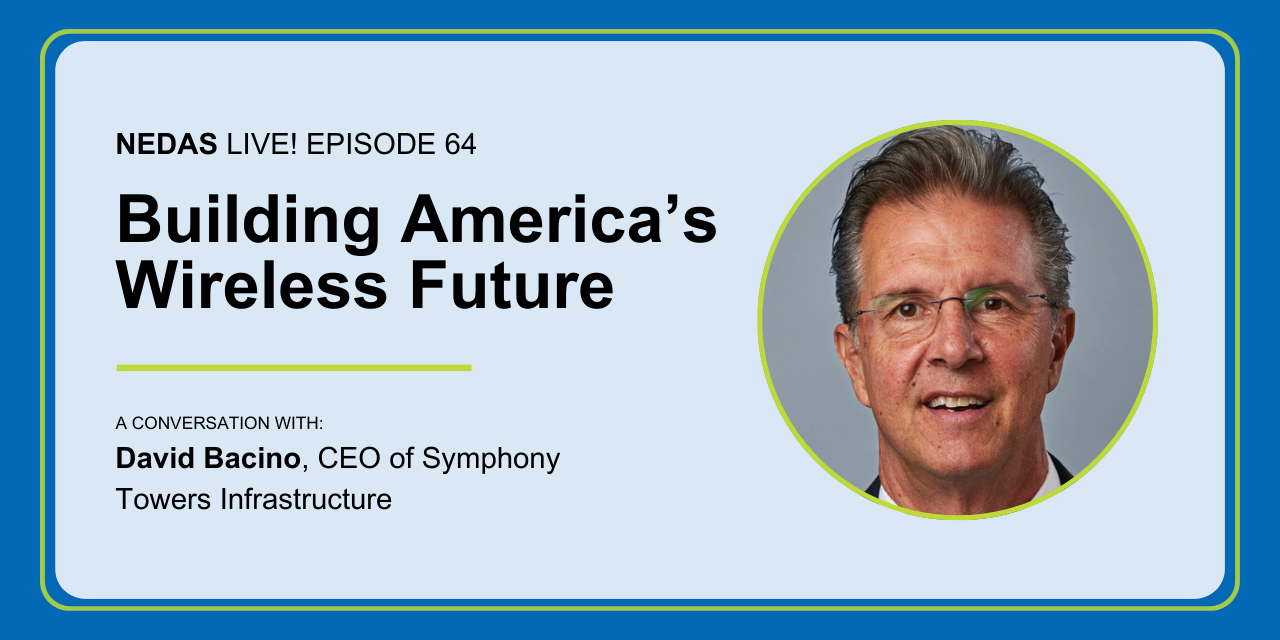
In the latest episode of NEDAS Live!, host Ilissa Miller welcomes David Bacino, CEO of Symphony Towers Infrastructure, for a candid conversation about the evolution of wireless infrastructure. Drawing on more than three decades in telecom and digital infrastructure, Bacino reflects on a career that has spanned leadership roles with wireless carriers, equipment manufacturers, and infrastructure ownership platforms. He notes that what keeps him energized is the ever‑changing, never‑boring nature of the industry and the fact that people now depend on wireless connectivity every day, whether for voice, data, or rich content.
Episode 64 highlights Bacino’s recent appointment as CEO of Symphony Towers in 2025 following Palistar’s integration of CTI’s towers and national telecom easements portfolio. The conversation also discusses his prior roles as CEO of CTI Towers and President of Melody Wireless Infrastructure, where he helped lead a landmark sector exit. Today, as he oversees roughly 3,000 wireless assets across all 50 states, Bacino is focused on how this platform can support the growing demands of carriers and end users alike.
Building a Hard-Asset Platform for Carrier Needs
Bacino explains that Symphony Towers Infrastructure is fundamentally a hard‑asset business, not a services company. The platform owns towers and rooftop rights that provide physical locations for antennas and radio equipment deployments, giving wireless carriers and other users the critical points they need to build and expand their networks. Backed by Palistar Capital, Symphony Towers operates with a dual mandate: acquire as many financially sound tower and rooftop assets as possible each year, and “lease up” those assets so carriers can use them to their fullest capacity.
A key strategic move discussed in the episode is Palistar’s decision to integrate Symphony Wireless into CTI Towers under the Symphony Towers banner. Rather than having two separate 1,500‑asset entities engaging the same carriers, the combined platform now approaches operators as a single company with more than 3,000 assets. For Bacino, this consolidation makes it easier for carriers, like AT&T, Verizon, and T‑Mobile, to interface with one partner for network locations and equipment installations and enables more robust, strategic conversations instead of one‑off, site‑by‑site evaluations.
Growth, 5G, 6G and the Broader Infrastructure Landscape
When Miller asks about Symphony Towers’ growth goals and geographic focus, Bacino breaks the answer into three parts. First, the company aims to acquire new assets where carriers demonstrate demand. Second, it strives to drive utilization across its existing sites, ensuring each asset delivers maximum value. Third, while Symphony Towers is focused across the entire U.S. rather than prioritizing one region over another, the team is ready to pivot if a carrier identifies a specific area or “mobile desert” where additional coverage and capacity are needed.
On technology, Bacino is clear that there is still plenty of work to do with 5G; upgrading from 4G to 5G nationwide is necessary for consistent network performance. Looking ahead, he sees real advantages and room for future technologies such as 6G, particularly for high‑demand use cases like streaming video, live business meetings, and other bandwidth or speed‑sensitive applications. He also frames wireless infrastructure in the broader context of the digital ecosystem, noting that data centers, subsea cables, and other platforms all ultimately rely on reliable wireless links to reach people’s devices. As he observes, it is now rare to attend any meeting, lunch, or dinner where someone does not have a mobile device in front of them. Wireless connectivity has become woven into everyday life.
Partnering with Municipalities and Communities
The conversation moves into how infrastructure providers like Symphony Towers can better partner with municipalities. When Miller raises the challenges of zoning, permitting, and community expectations, Bacino flips the question: the real key, he says, is for municipalities to clearly communicate what they need and expect. He points to “stealth” towers, sites designed to blend into the environment, such as structures that look like pine trees or rocks, as examples of how infrastructure can be deployed in ways that respect local aesthetics and ordinances, provided those requirements are defined up front.
Miller connects this to her work with the OIX Association’s Digital Infrastructure Framework Committee, which aims to educate city planners and economic developers about proactively master‑planning digital infrastructure. The goal is to help communities understand what they have, what they need to support government services and businesses, and what kind of place they want to become, whether a smart city, a tech hub, or something else. Bacino notes that municipalities are generally focused on supporting their residents and constituents, and that companies like Symphony Towers can step in as partners once there is a clear vision and strong communication around objectives and end‑state goals.
To continue the conversation, listen to the full podcast episode here.

