
TL;DR
- True data sovereignty goes beyond physical storage location (residency) to demand enforceable organizational control over encryption keys, backup systems, administrator access, and legal jurisdictions.
- Managing massive, proprietary, or regulated datasets for artificial intelligence creates high costs and compliance hurdles, pushing enterprises to run AI workloads closer to governed data via private or hybrid infrastructure.
- While private infrastructure has its own physical costs, running predictable, data-heavy workloads on-premises or in colocation facilities provides more stable economics and easier auditability compared to public cloud sprawl.
# # #
For years, the public cloud was treated as the natural destination for enterprise infrastructure. The logic was simple: move workloads to hyperscale platforms, gain speed and flexibility, and reduce the burden of managing physical hardware. That model still works for many applications, especially those with unpredictable demand, distributed users, and strong cloud-native design.
But a new pressure is reshaping enterprise cloud strategy: data sovereignty.
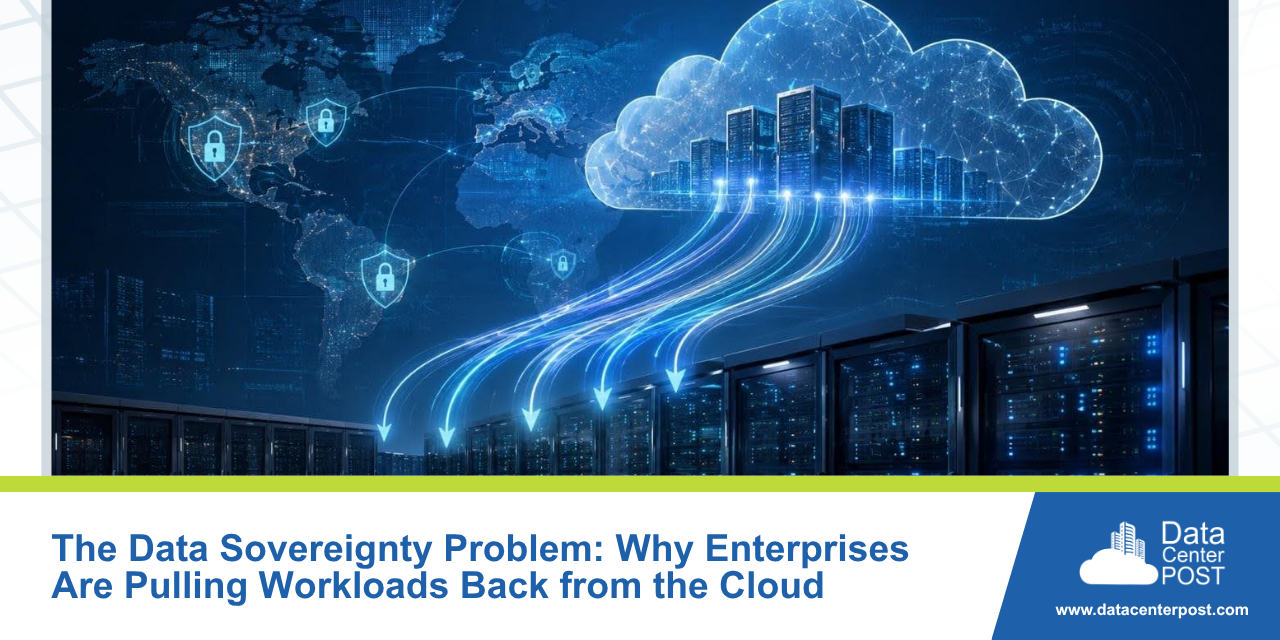
Enterprises are no longer asking only where their applications run. They are asking where their data resides, who can access it, which jurisdiction governs it, how it is encrypted, how it is backed up, and whether they can prove all of that during an audit or incident. For many organizations, especially in regulated industries, those questions are pushing certain workloads back toward private cloud, colocation, and on-premises data center environments.
Data Sovereignty Is More Than Data Residency
Data residency is about location. It answers the question: “Where is the data stored?”
Data sovereignty goes further. It asks whether the organization has enforceable control over the data, the infrastructure, the administrators, the encryption keys, the backup copies, the logs, and the legal environment around all of it. A workload can technically be hosted in the right country and still create sovereignty concerns if management access, support operations, replication, or metadata flows cross borders in ways the enterprise cannot fully govern.
That distinction matters because enterprise IT environments are rarely simple. Data may be created in one region, processed in another, backed up in a third, and accessed by support teams from multiple jurisdictions. In a single-cloud or multi-cloud environment, this can happen quickly and invisibly unless governance controls are built into the architecture from the beginning.
Why Cloud-First Is Becoming Workload-First
The movement back from the cloud is not a rejection of cloud computing. It is a sign that enterprise infrastructure strategy is maturing.
A decade ago, “cloud-first” became the default strategy for many companies. Today, more IT leaders are adopting a workload-first model. Instead of asking, “How do we move this to the cloud?” they are asking, “Where should this workload live based on risk, cost, performance, compliance, and control?”
That change is especially visible in workloads involving sensitive customer records, financial data, healthcare information, intellectual property, AI training datasets, backup repositories, and operational systems that cannot tolerate uncertain jurisdictional exposure. For these workloads, the economics and governance of public cloud can become more complicated than expected.
The result is selective repatriation. Enterprises may keep collaboration tools, web applications, and elastic development environments in public cloud while moving steady-state databases, high-volume storage, backup data, and latency-sensitive systems into infrastructure they control more directly.
Regulation Is Raising the Bar
Regulatory pressure is one of the strongest drivers behind this shift. Laws and industry frameworks around privacy, operational resilience, cross-border data transfer, and third-party technology risk are becoming more detailed. Boards and regulators increasingly expect organizations to demonstrate control, not simply outsource trust to a cloud provider.
For financial services, healthcare, government, defense, and critical infrastructure organizations, the question is no longer whether a provider has strong security. Most major providers do. The question is whether the enterprise can produce evidence that the right controls are in place, that data is handled according to policy, and that recovery can happen under pressure.
This is where private infrastructure, sovereign cloud models, and colocation environments are becoming more attractive. They allow organizations to define stricter boundaries around data location, administrator access, encryption key custody, network paths, and backup retention. In many cases, they also simplify audits because the environment is easier to map and explain.
AI Is Making the Problem Bigger
Artificial intelligence is adding another layer to the sovereignty discussion. AI systems depend on large volumes of data, and many enterprises are now trying to determine where that data should be stored, processed, indexed, and used for model training or inference.
Moving massive datasets into and out of cloud platforms can create cost, latency, and governance challenges. More importantly, organizations must understand whether sensitive data is being exposed to external services, retained in logs, used in model workflows, or replicated across regions.
For some AI use cases, public cloud will remain essential because of GPU availability and managed AI services. But for workloads involving proprietary datasets, regulated information, or long-term data retention, enterprises are increasingly exploring private AI infrastructure, hybrid architectures, and data-center-based processing models. The goal is not to avoid AI; it is to bring compute closer to governed data.
Cost and Control Are Connected
While sovereignty is often discussed as a compliance issue, it is also a cost issue. Large cloud environments can become expensive when workloads are predictable, data-heavy, or constantly moving between services and regions. Egress fees, storage growth, backup retention, replication, and underused resources can turn cloud flexibility into cloud sprawl.
Repatriating a workload does not automatically make it cheaper. Private infrastructure comes with its own costs: hardware, power, cooling, staffing, lifecycle management, and physical security. But for steady workloads with known utilization patterns, enterprises may gain more predictable economics by running them in private environments or colocation facilities.
That predictability matters. When infrastructure supports critical data, cost control and governance are linked. Organizations need to know not only what they are spending, but also what risk they are accepting in exchange for that spend.
What Enterprises Should Evaluate Before Repatriating
Pulling workloads back from the cloud should not be a reactionary move. It should be a structured decision based on technical and business requirements.
Enterprises should begin by classifying their workloads and data. Which systems contain regulated information? Which datasets are subject to regional restrictions? Which applications generate high data movement costs? Which workloads have stable demand? Which systems require low latency or strict recovery guarantees?
Next, they should review access and control. Who can administer the environment? Where are encryption keys stored? How are backups protected? Can the organization prove where data is located and how it is replicated? What happens if a provider outage, contract dispute, or geopolitical event affects access?
Finally, enterprises should design for portability. The strongest infrastructure strategies do not lock every workload into one environment. They use cloud where cloud adds value, private infrastructure where control is required, and colocation where resilient, connected, professionally managed facilities can bridge the two.
The Future Is Hybrid, but More Intentional
The future of enterprise infrastructure is not purely public cloud or purely on-premises. It is a more intentional hybrid model.
Public cloud will continue to support innovation, scalability, global reach, and managed services. But data centers, colocation facilities, private cloud platforms, and sovereign infrastructure will play a larger role in workloads where jurisdiction, auditability, cost predictability, and operational control are critical.
For many enterprises, the answer is not to abandon cloud completely, but to regain control over the parts of the environment that carry the most regulatory or operational risk. Private infrastructure, colocation, and hybrid storage models are becoming more important because they help organizations define clearer boundaries around data location, encryption, access control, backup retention, and recovery. In this model, private cloud storage can support a more controlled approach to storing and protecting sensitive workloads without fully giving up cloud-like scalability.
The data sovereignty problem is forcing enterprises to rethink an assumption that shaped the last decade: that moving to the cloud always means gaining control. In reality, control depends on architecture. For some workloads, the best answer is still public cloud. For others, the answer is bringing data and compute closer to infrastructure the enterprise can govern directly.
The companies that succeed will not be the ones that simply move everything back or push everything forward. They will be the ones that understand their data, classify their risk, and place each workload where it belongs.
# # #
About the Author
George Williams has over 13 years of experience in the data storage, backup and disaster recovery, and archiving markets. A true geek with love for ease and simplicity in data storage, George has been working for StoneFly Inc. for over a decade. Ever since StoneFly started shipping products in 2006, George has been working to ensure that technical information is relayed in a simple and effective way to customers and targeted audiences. George helps curate content and works with numerous publishers and technology blogs to spread awareness and knowledge of data storage technology.

