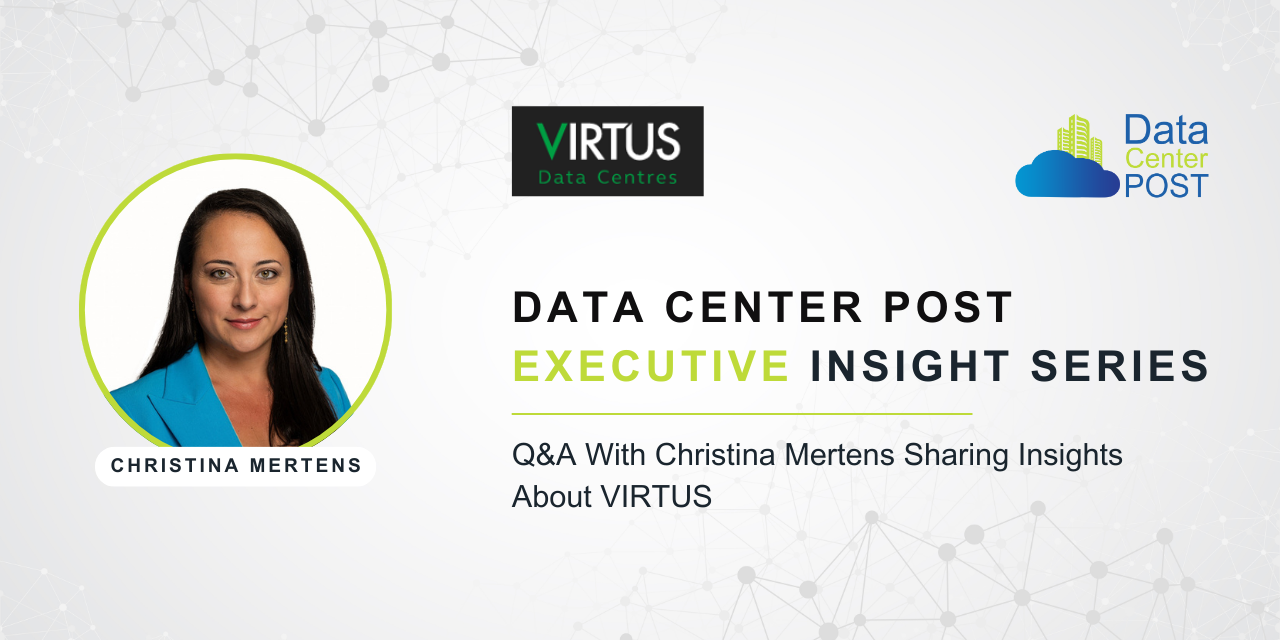
Data Center POST had the opportunity to connect with Christina Mertens, who joined VIRTUS as VP Business Development EMEA in June of 2022. With her she brings over ten years’ experience in developing strategies for, and expanding, existing and new hyperscale infrastructure geographies across EMEA.
For the past decade, she has worked for Amazon in EMEA, where she expanded the existing AWS data centre regions in colocation and self-built facilities, as well as launched new region geographies as the country manager. In her previous role as Data Center Divestiture Principal at Amazon Web Services in EMEA, Christina worked alongside large strategic hyperscale cloud customers, advising them on their infrastructure assets and developing new models to facilitate and enhance their cloud migration journey. She is the Managing Director of Germany and Italy, responsible for overseeing all aspects of the business, including expansions, sales, data centre design, construction and operations.
The information below is summarized to provide our readers a deeper dive into who VIRTUS is, what they do and the problems they are solving in the industry.
What does VIRTUS do?
VIRTUS is a European data centre provider and the largest in the UK. With over 10 years of experience, whichever sector a business operates in, VIRTUS tailors solutions to specific customer requirements.
What problems does VIRTUS solve in the market?
Businesses have unique workloads, project durations and changing requirements. VIRTUS’ solutions are designed to provide the digital infrastructure which supports these needs. Built to a vast scale, all of our data centres are designed modularly, allowing full flexibility for data centre customers’ requirements. Our facilities operate using 100% renewable energy and are amongst the most efficient facilities in the world.
What are VIRTUS’ core products or services?
We build AI-ready, built to suit and colocation data centres.
VIRTUS’ AI Ready Data Centres are designed to support the high performance computing (HPC) demands of artificial intelligence workloads. Our facilities provide the optimum environment for HPC deployments of any size, including the next generation of AI IT infrastructure and Machine Learning (ML) workloads, which require next generation cooling deployment and increased power per rack.
Our built to suit data centres are those designed specially for the customer. We know that organisations of all sizes need real flexibility, which is why we work with our customers to create bespoke solutions. For example, some require cutting-edge AI solutions which may require space to scale at speed, others might have a hyperscale cloud deployment that needs custom built data halls.
Our colocation service is designed to provide maximum flexibility with individual IT power and space requirements. The modular facilities are designed to scale up with customer growth. This combined with truly flexible commercials allows customers to grow in a cost efficient and unrestrictive environment.
What markets do you serve?
VIRTUS’ European data centres are strategically located in key markets; currently this is London (UK), Berlin (Germany) and Milan (Italy). As part of ST Telemedia Global Data Centres’ (STT GDC) global platform, we have a presence in ten geographies, more than 101 data centres and over 2GW of IT load across 20+ major business markets.
Our vast experience comes from working with many industry sectors – from financial institutions which require ultra-low latency, to thriving tech start ups which rely on contiguous space to grow, and providing entire buildings or campuses for the world’s largest hyperscalers.
What challenges does the global digital infrastructure industry face today?
Many current European data centres simply cannot meet the short- and long-term demands for critical digital infrastructure, often due to a shortage of infrastructure that can support high HPC workloads. It is a fundamental challenge to find land with access to renewable power to build new facilities, quickly and at scale.
For years, development revolved around a handful of key metropolitan hubs. Frankfurt, London, Amsterdam and Paris (collectively known as the FLAP locations) carried much of the continent’s cloud, enterprise and interconnection load, due to their proximity to financial services, global carriers and concentrated digital ecosystems.
Undoubtedly, whilst those hubs continue to grow, their conditions have changed. Power supply is being delayed due to parts of the electricity distribution network not being capable of transporting it, suitable land parcels are becoming scarcer and therefore more expensive to secure, and planning regulations are increasing, lengthening timelines to approvals, if they are granted at all.
Meanwhile, demand for computing power is surging in ways that surpass forecasts made even two years ago. AI training and inference, HPC, analytics and modernised public services all require significant and sustained energy and cooling capacity.
McKinsey suggests that global demand for data centre capacity could more than triple by 2030. It is clear that Europe needs more digital infrastructure, but it needs that infrastructure in places with the headroom and regulatory clarity to support long term expansion. And this is partly why what is sometimes known as the second-tier locations are becoming increasingly more critical to expanding Europe’s digital architecture.
Over the next five years, this is not a marginal shift. Analysts expect Europe’s installed data centre capacity to more than double, from roughly 24 GW in 2025 to around 55 GW by 2030, with secondary markets growing fastest. And, while recent CBRE analysis indicates that in 2025, around 57% of new capacity will still be delivered in the core FLAP-D markets, the remaining 43% will come from secondary locations such as Milan, Madrid and Berlin, many of which are now on track to exceed 100 MW of installed capacity in their own right. This is the context in which tier two locations are moving from “nice to have” to essential if Europe is to keep pace with global demand.
How is VIRTUS adapting to these challenges?
Our strategy is to build new facilities at scale, located close to, but not necessarily in major European metropolitan cities, and supplied with renewable energy.
We are currently building a €3bn 300MW data centre campus development at Wustermark, west of Berlin. Wustermark offers what many central locations cannot – land large enough for a multi-building campus, access to sustainable electricity, proximity to rail and motorway networks, and alignment with Germany’s policy focus on digital capacity. The site is also positioned to benefit from Germany’s wider energy and grid modernisation programmes, including access to renewable energy to power the campus as it is adjacent to Germany’s largest on-shore windfarms capable via a substation and direct coupling, of fulfilling the energy requirements of the facility.
This move towards larger campuses is a calculated strategy that acknowledges the non-linear cost relationship inherent in these types of operations; larger megascale campuses capable of 200-500MWs can often afford providers – and therefore customers – greater efficiencies.
We are also constructing another facility in Italy. Located in Cornaredo, within the Milan West data centre cluster the site will provide ample capacity to support hyperscalers, enterprises and service providers as digital infrastructure demands in Europe continue to grow.
What are VIRTUS’s key differentiators?
What sets VIRTUS apart from our competitors can be found in many aspects of the design, build and operations of our facilities. However, the quality of operations – the Operational Excellence – is where we truly excel. The way we have implemented design innovations makes a difference to the service we provide in terms of efficiency and resilience. It’s how we design, build, test, maintain, change and operate our facilities that differentiates us – ensuring robust and reliable availability is delivered.
What can we expect to see/hear from VIRTUS in the future?
It’s an exciting time for VIRTUS Europe, but to meet customer demand we’re still increasing our presence as the leader in the UK market, opening two new London data centres in 2026 (LONDON12 and LONDON14) and in the near future a large four data centre campus at Saunderton, whilst continuing our European expansion.
What upcoming industry events will you be attending?
The VIRTUS team is attending the following events: Platform UK where Adam Eaton will be speaking on a keynote panel, Energy Storage Summit where Helen Kinsman will be speaking on a panel, Compute Summit where Ramzi Charif will be speaking on a panel, and finally Datacloud Energy where Helen Kinsman will be speaking on another panel.
Do you have any recent news you would like us to highlight?
Earlier in 2026 we announced VIRTUS’ new CEO, Adam Eaton. Under his leadership, we will continue to expand our portfolio of high-efficiency, sustainable data centres, building on more than a decade of rapid growth across the UK and Europe. VIRTUS remains committed to its vision to deliver world-class, energy-efficient infrastructure that supports the growth of the digital economy.
Where can our readers learn more about VIRTUS?
You can learn more about us on our website, www.virtusdatacentres.com.
How can our readers contact VIRTUS?
You can contact us through the form on our website, www.virtusdatacentres.com/contact-us.
# # #
About Data Center POST
Data Center POST provides a comprehensive view of the digital infrastructure landscape, delivering industry insights into the global data center ecosystem. As the industry’s only peer-contributed and online publication, we offer relevant information from developers, managers, providers, investors, and trendsetters worldwide.
Data Center POST works hard to get the most current information and thought-provoking ideas most apt to add relevance to the success of the data center industry. Stay informed, visit www.datacenterpost.com.
If you are interested in contributing to Data Center POST, contact us at contributions@datacenterpost.com or submit your article here.
Want more digital infrastructure news? Stay in the know and subscribe to Data Center POST today!