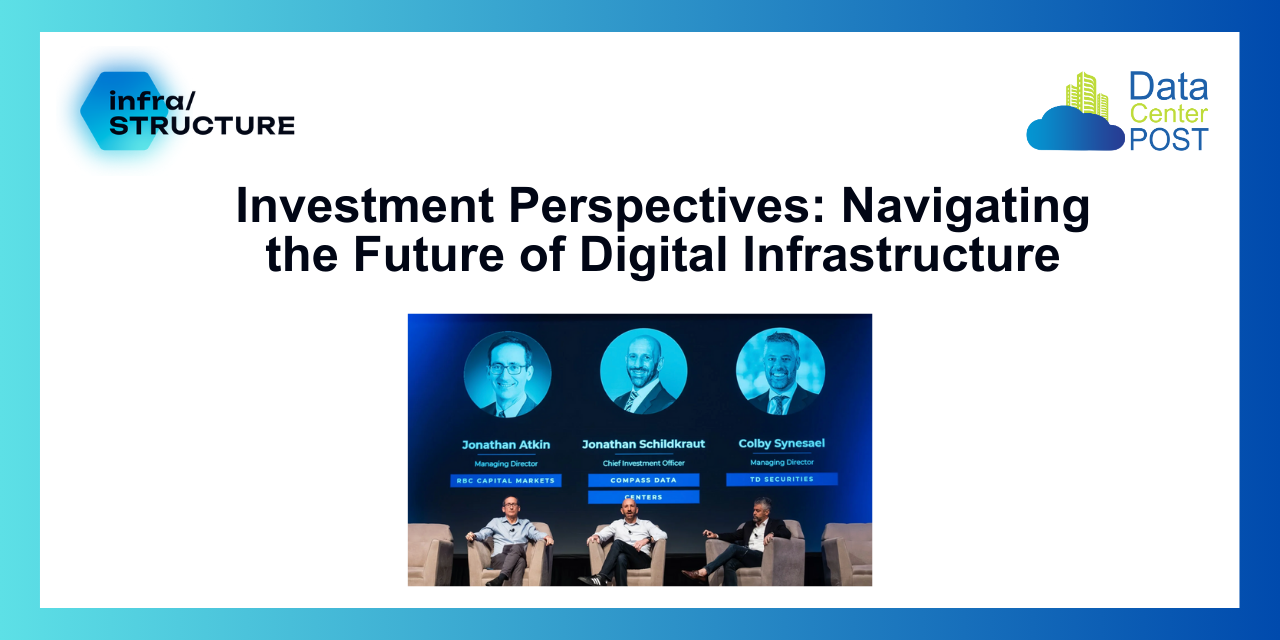
Insights from RBC Capital Markets, Compass Datacenters, and TD Securities
Understanding the Investment Landscape in a New Era of AI
The infra/STRUCTURE Summit 2025, held October 15–16 at the Wynn Las Vegas, brought together the world’s leading voices in digital infrastructure to explore the industry’s rapid transformation. Among the standout sessions was Investment Perspectives, where experts discussed how artificial intelligence (AI), energy constraints, and capital strategy are reshaping investment decisions and the future of data center development.
Moderated by Jonathan Atkin, Managing Director at RBC Capital Markets, the panel featured Jonathan Schildkraut, Chief Investment Officer at Compass Datacenters, and Colby Synesael, Managing Director at TD Securities. Together, they provided clear insights into the trends influencing where, why, and how capital is being deployed in the infrastructure sector today.
The Shifting Demand Curve: How AI is Driving Data Center Growth
Jonathan Schildkraut opened the discussion by outlining the four primary workloads fueling infrastructure demand: AI training, AI inference, cloud, and social media. He described these workloads as the engines of growth for the sector, emphasizing that most are revenue-generating. “Three of those four buckets are cash registers,” Schildkraut said. “We’re really seeing those revenue-generating workloads accelerating.”
Colby Synesael added that the balance between AI training and inference is shifting quickly. “A year ago, roughly 75% of AI activity was training and 25% inference,” Synesael explained. “In five years, that ratio could reverse. A lot of inferencing will occur near where applications are used, which changes how we think about data center deployment.” Their remarks highlighted a clear message: AI continues to be the dominant force shaping infrastructure demand, but its evolution is redefining both scale and location.
Market Expansion and Power Constraints
As Tier 1 data center markets face mounting limitations in available land and energy, both Schildkraut and Atkin noted the increasing strategic importance of Tier 2 and Tier 3 regions. Schildkraut cited examples such as Alabama, Georgia, and Texas, which are emerging as viable alternatives due to improved fiber connectivity and more favorable power economics.
Capital Strategy and Facility Adaptability:Investing for the Long Term
The conversation also delved into how investors are evaluating opportunities in an environment of high demand and rapid technological change. Schildkraut explained that access to capital today depends on two critical factors: tenant quality and facility adaptability. “Investors want to know that the tenant and the workload will be there for the long term,” Schildkraut said. “They also care deeply about whether the facility can evolve with future technologies.”
To illustrate this, Schildkraut described Compass Datacenters’ initiative to upgrade power densities, increasing capacity from 6–7 kilowatts per rack to hybrid systems capable of supporting up to 30 kilowatts. This investment is designed to ensure readiness for the next generation of high performance computing and AI workloads. These types of forward looking strategies are helping operators and investors manage both risk and opportunity in an increasingly complex market.
Globalization and Policy Influence
When the conversation turned to global trends, Schildkraut predicted that AI infrastructure deployment will expand worldwide but at uneven rates. “Availability of power and land isn’t uniform,” he said. “Government incentives will play a critical role in determining which markets can scale.”
Synesael agreed, adding that regions lacking modern AI infrastructure could face growing disadvantages. “Over the next several years, not having this infrastructure in your country or region will become a major constraint on innovation,” Syneasel said. Their perspectives reinforced that infrastructure development is no longer just a commercial priority, it is also a matter of national competitiveness.
A Market Redefined by Technology and Energy
The discussion revealed that the digital infrastructure market is entering a new phase defined by the convergence of AI driven workloads, energy constraints, and strategic capital deployment. As inference workloads expand, Tier 2 and Tier 3 markets rise in importance, and investors prioritize long-term flexibility, the industry’s success will depend on adaptability and foresight. The session made it clear that data centers are no longer just real estate, they are foundational assets powering the next wave of global innovation.
Infra/STRUCTURE 2026: Save the Date
Want to tune in live, receive all presentations, gain access to C-level executives, investors and industry leading research? Then save the date for infra/STRUCTURE 2026 set for October 7-8, 2026 at The Wynn Las Vegas. Pre-Registration for the 2026 event is now open, and you can visit www.infrastructuresummit.io to learn more.