
Insights from Structure Research, Cloudflare, Decillion, Groq, and Lambda
Why Hyperscale Procurement Matters Now
At the infra/STRUCTURE Summit 2025, held October 15–16 at the Wynn Las Vegas, the session on Hyperscale Data Center Procurement explored how hyperscalers, cloud platforms, and AI companies are redefining site selection, capacity planning, and power procurement.
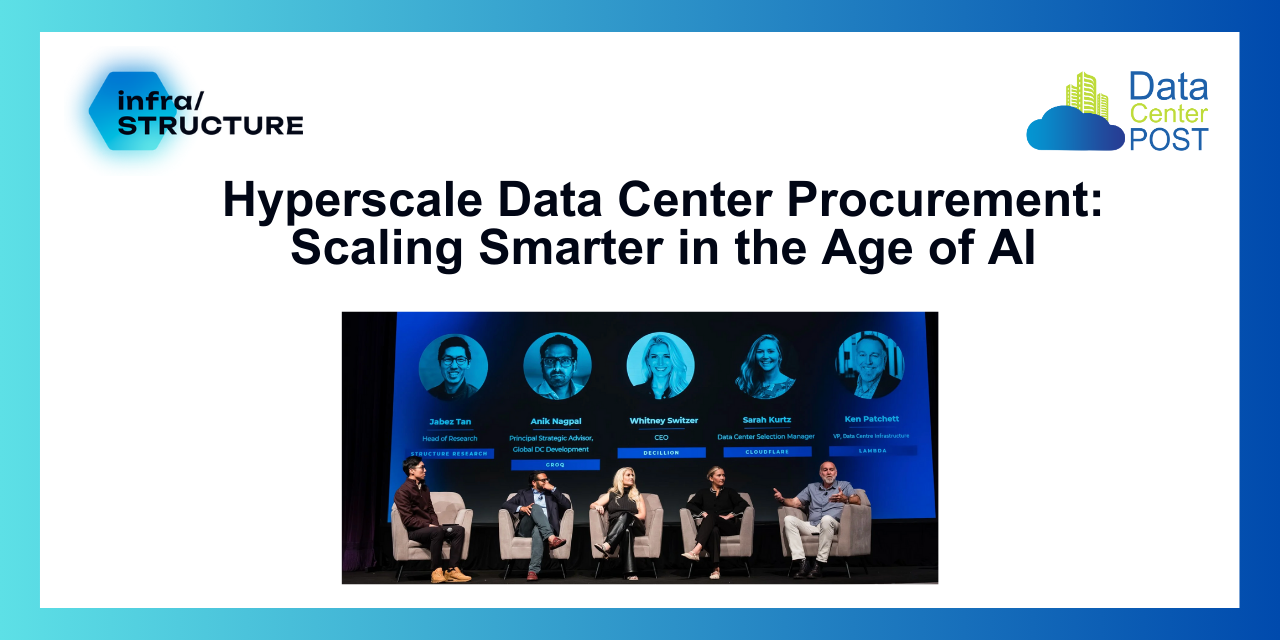
With the explosion of artificial intelligence (AI) and high-performance workloads, the panel examined how data center operators are adapting to meet new demands for speed, density, and collaboration. The discussion brought together leading experts who sit at the intersection of technology, infrastructure, and strategy: Jabez Tan, Head of Research at Structure Research; Sarah Kurtz, Data Center Selection Manager at Cloudflare; Whitney Switzer, CEO of Decillion; Anik Nagpal, Principal Strategic Advisor for Global Data Center Development at Groq; and Ken Patchett, VP of Data Center Infrastructure at Lambda.
Together, they offered a grounded yet forward-looking view of how hyperscale infrastructure is evolving and why collective problem-solving across the ecosystem has never been more urgent.
Understanding the New Procurement Reality – From Megawatts to Gigawatts
Moderator Jabez Tan opened by noting how quickly the scale of data center procurement has transformed. Just a few years ago, hyperscale planning revolved around megawatts. Today, as Ken Patchett of Lambda explained, “We used to talk in megawatts; now we’re talking in gigawatts or even hundreds of megawatts. The world has changed.”
Patchett emphasized that this growth is not theoretical; vacancy rates are at record lows, and facilities are being leased before construction even begins. “Seventy-three percent of buildings being built in the U.S. today are pre-leased before completion,” he said. “In some cases, they’re 100 percent committed before a shovel hits the ground.”
This surge underscores both the opportunity and the strain on today’s hyperscale procurement models. The traditional development timelines, often five years from land acquisition to delivery, are being tested by the speed at which AI and GPU-driven workloads are scaling.
Site Selection and Power – Seeing Through the Noise
Whitney Switzer, CEO of Decillion, offered insights into the increasingly complex process of site selection, especially in an environment filled with speculation and limited power capacity. “There’s a lot of land and a lot of promises,” Switzer said, “but not all sites can actually deliver what hyperscalers need. The challenge is cutting through the noise to identify real, deliverable power and real infrastructure.”
Anik Nagpal from Groq added that power availability has become the defining factor in any site’s viability. “We’re facing long waiting lists with utilities,” Nagpal explained. “It’s not enough to have a site, you need documented substation agreements, confirmed transformer orders, and clear delivery dates.” Without that level of verification, even well-positioned properties can fall short of hyperscale timelines.
Switzer reinforced that the industry must move toward deeper collaboration between developers, power providers, and end users to accelerate readiness. “You have to build trust,” she said. “That’s what ensures creativity and alignment between the business and technical sides of a deal.”
Market Challenges and Evolving Partner Strategies
Sarah Kurtz of Cloudflare described a rapidly tightening capacity market, where competition for space and power is fierce. “Prices have moved dramatically,” Kurtz said. “We might go out for one megawatt and come back to find that the same capacity now costs four times as much.” Despite those pressures, Kurtz highlighted that the key is adaptability, knowing when to secure smaller, strategic sites that can deliver sooner rather than waiting years for larger campuses.
Ken Patchett echoed this sentiment, pointing out that the demand wave is forcing new forms of partnership. “We’re all asking, ‘Do you have space? Do you have power?’ Conversations that didn’t happen ten years ago are now everyday,” Patchett said. “We have to work together, utilities, operators, AI companies, to actually build the infrastructure that matches the pace of technology.”
Nagpal added that power immediacy and transparency are now central to deal-making. “People want to believe the power’s there,” he said, “but you only know it when you see the agreements in writing. That’s the new due diligence.”
Designing for Density and Agility – Building for the Next Cycle
A recurring theme throughout the session was that data center design itself must evolve as hardware cycles shorten. Patchett underscored that density and adaptability are now fundamental requirements. “The buildings we designed 20 years ago won’t support what we’re running today,” Patchett said. “We’re moving from 50-kilowatt racks to 600-kilowatt racks, and we have to build in a way that can pivot every six to nine months as hardware changes.”
Patchett added that despite fears of overbuilding, the industry isn’t facing a bubble. “We’re still using what we built ten or twenty years ago,” he said. “This is about addition, not replacement. Our challenge is to keep up with demand, not question it.”
The panelists agreed that modular design, flexible financing, and shared innovation will define the next phase of data center evolution. As Switzer summarized, “It’s all about partnership, aligning resources and expertise to deliver creative solutions at scale.”
Collaboration as the New Competitive Edge
The session made clear that hyperscale procurement is no longer about simply buying power and land. It’s about integrating supply chains, synchronizing with utilities, and designing for continuous evolution. Across every perspective, developer, operator, and end user, the message was the same: collaboration is the only way to scale sustainably.
The leaders on stage shared a unified view that as AI reshapes data center demand, the industry’s success will depend not on who builds fastest, but on who builds smartest—with transparency, trust, and long-term partnership at the core.
Infra/STRUCTURE 2026: Save the Date
Want to tune in live, received all presentations, gain access to C-level executives, investors and industry leading research? Then save the date for infra/STRUCTURE 2026 set for October 7-8, 2026 at The Wynn Las Vegas. Pre-Registration for the 2026 event is now open, and you can visit: www.infrastructuresummit.io to learn more.

